
The Hermès HAC: A Complete Archive
Every size and format: HAC 28 through HAC 55, Cargo, and à Dos
The Haut à Courroies, literally "high with straps," predates the Kelly and the Birkin by decades. Originally built to transport equestrian equipment in the early 20th century, it was the first structured bag Hermès produced at scale. The Kelly formalized in 1977 and the Birkin in 1984, but the HAC never stopped production. It simply became quieter: fewer units per season, less retail visibility, and a collector profile that skews toward buyers who have already completed the canonical forms and are looking for what came before them.
The HAC's defining proportion is its vertical orientation. Unlike the Birkin, which is wider than it is tall, the HAC is taller than it is wide. The double-strap closure system, the courroies, runs over the top flap and buckles at the front, giving it a fastening logic closer to a traveling trunk than a handbag. The result is a bag with significantly more interior volume than its exterior footprint suggests.
JaneFinds has handled over 45 HAC examples across all sizes and formats. What follows is a complete reference.
HAC 28

The HAC 28 is the smallest and least frequently produced HAC configuration. It occupies an unusual position in the collection: small enough to function as a day bag but structured enough to carry the HAC's formal proportions without looking abbreviated. Most collectors encounter it once, if at all.
White Epsom in this size is a collector-grade rarity: the combination of an uncommon HAC size with a light colorway that demands pristine condition creates a narrow window of acceptable examples. The K Square stamp on the example above places it in 2007.
On the secondary market, the HAC 28 trades infrequently and commands premiums when it does appear, driven primarily by scarcity rather than demand, demand being difficult to build for a format few collectors have seen in person.
HAC 32

The HAC 32 is the most wearable of the vintage HAC sizes. Its proportions, taller than the Kelly 32 but narrower than the HAC 40, give it a distinct silhouette that reads as purposeful rather than oversized. It was produced consistently through the Circle and Square eras and appears regularly in the secondary market in good vintage condition.
Material variety in the HAC 32 is broad: Ardenne, Gulliver, Box, Vibrato, Chèvre, Ostrich, and Toile combinations all appear across the JaneFinds archive. The Rouge Vif Ostrich example above is among the more visually striking; ostrich's follicle pattern catches light differently at this scale, and Rouge Vif at this saturation has no quiet reads.
JaneFinds has handled eight HAC 32 examples including gray Vibrato with Black Box, Ebène Ardenne, Vert Foncé Ardenne, Denim/Blue Jean Gulliver, Parchemin Ostrich with Toile, and Cardamom Chèvre. The consistent thread across all of them: the HAC 32 rewards buyers who understand the format's history and are not simply buying a Birkin alternative.
HAC 40

The HAC 40 is the reference format: the size against which all other HAC configurations are measured. It is taller than it is wide (40cm tall, 30cm wide), a proportion that immediately distinguishes it from the Birkin 40 on the same shelf. The interior volume is substantial: the double-strap closure system accommodates considerably more than the exterior suggests.
Standard leather HAC 40s appear most frequently in Togo and Clemence, which hold the bag's tall structure without becoming stiff. Etoupe, Black, White, Gold, Malachite, Blue Thalassa, Blue Nuit, and Dark Bronze are all represented across JaneFinds' HAC 40 archive. The Blue Nuit/Gris Moyen example with wool feutre panels is among the more unusual standard-leather configurations, a material combination that references the bag's equestrian origins without resorting to Toile.
HAC 40 – Exotics

Exotic HAC 40s represent a distinct sub-category with their own secondary market logic. The volume of skin required to produce a HAC 40 in Porosus Crocodile is significantly greater than for a Birkin 25 or Kelly 28; the scale premium compounds at this format. Matte finish in black is the most formal and most sought-after crocodile HAC configuration; shiny finish in black and full Porosus in Bleu Marine (2018 C Square) are also in the JaneFinds archive.
The HAC 40 in full exotic has been produced in Porosus Crocodile (matte and shiny), Niloticus Crocodile, and Lizard. Poussière in Porosus Crocodile, a warm beige-taupe, is one of the rarer color/skin combinations and appeals to buyers who want maximum material presence without maximum contrast.
A Doblis suede and crocodile combination also appears in the archive: Black Doblis body with a glossy crocodile center panel, Gold Hardware. That configuration is documented separately in the HAC comparison post.
HAC 40 – Special editions

The HAC 40 has appeared in several runway and special-edition formats that do not enter standard retail. The Lime/Ficelle Evercolor with Toile de Camp body above is a runway piece; Toile de Camp is a structured canvas developed specifically for Hermès travel goods and appears in limited bag production. The Lime Evercolor trim against the natural canvas ground is a color pairing that required the HAC's scale to fully resolve.
The Toudou is a second notable special format: Rose Azalée Evercolor leather combined with Gris Clair wool body panels. The Toudou construction references the original saddle-blanket heritage of the HAC format without being literal about it. It is the quietest interpretation of a bag that is rarely quiet.

The Toudou represents one of the more architecturally distinct HAC 40 interpretations. The wool panels occupy the same structural position as leather would in a standard HAC, but the textural contrast between the smooth Evercolor trim and the soft wool body creates a reading closer to a traveling rug bag than a leather good. In Rose Azalée over Gris Clair, the color balance is restrained enough to prevent the format from becoming costume.
Wool-bodied HAC 40s require specific care: wool panels are sensitive to water exposure and abrasion in ways that Togo or Clemence are not. Condition on the wool is the dominant valuation variable for these pieces.
HAC 45

The HAC 45 sits at the boundary between a large day bag and a serious overnight piece. At this scale, Clemence is the preferred leather; it softens with use in a way that makes the bag's substantial volume feel carried rather than lugged. Etrusque (a warm copper-bronze) in Clemence with Gold hardware is a combination that ages particularly well: the leather's natural softening over time suits the color's warmth.
JaneFinds' HAC 45 archive includes Etrusque Clemence, Vert Claire, Gold Ostrich, Buffalo (Red), and a plain burgundy-tone example. The Ostrich HAC 45 is among the more arresting pieces in the archive; the follicle pattern at this scale has a presence that smaller ostrich formats cannot match.
The HAC 45 in the secondary market is less consistently priced than the HAC 40: the buyer pool is narrower, and the condition premium is steeper given the bag's intended use as an active carry.
HAC 50
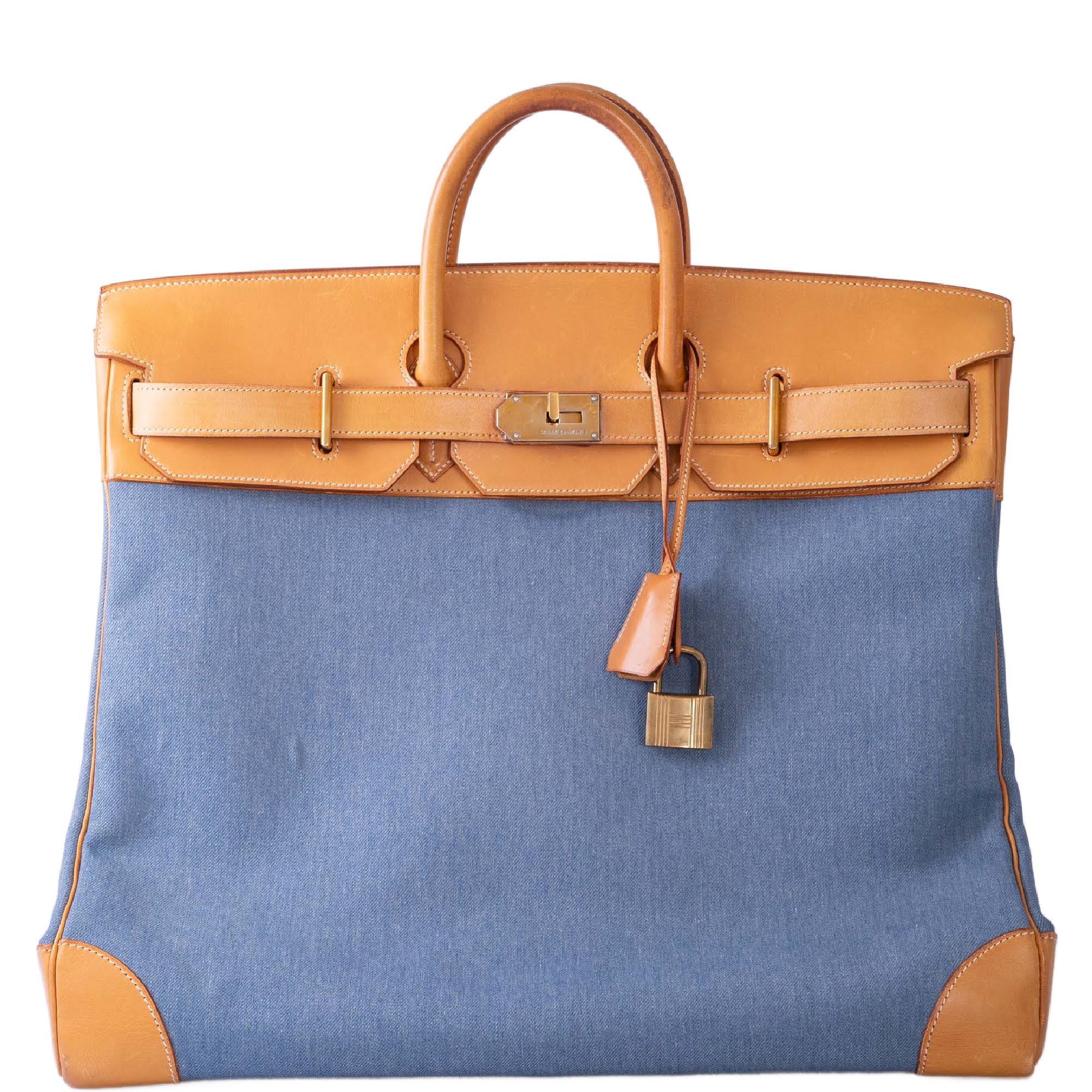
The HAC 50 is a traveling bag in the most literal sense: at 19.5" wide, it accommodates multiple days of clothing with room to spare. It was produced with greater regularity during the Circle and early Square eras, when Hermès was still producing an active travel goods line at scale. Current production is extremely limited.
JaneFinds' HAC 50 archive includes Ebène Porosus Crocodile with Bronze Hardware, Gris Tourterelle Shiny Porosus Crocodile, the vintage Denim and Naturelle Vache Liégée above, the Endless Road special edition (multicolor Togo and Swift), and the Voyager format in Black Togo (2021 Z stamp). The material range across these five pieces captures the full spectrum of HAC 50 production intent: archival leather travel goods, exotic statement pieces, and collaborative special editions.
The Endless Road HAC 50 deserves specific notation: a multi-color patchwork construction in Togo and Swift that references map cartography in its layout. It is one of the most ambitious compositional HAC 50s to have appeared on the secondary market.

The Endless Road is a patchwork construction executed at HAC 50 scale, one of the few special editions where the bag's large format is a prerequisite for the design to function. At smaller scales the composition would compress into noise; at 50cm it resolves into a legible, architectural arrangement of color and texture. Togo and Swift react differently to light within the same piece, creating a depth that monolithic single-leather construction cannot replicate.
The Endless Road is effectively a one-time encounter in the secondary market. If you have seen one before, you are in a narrow group.
HAC 55

The HAC 55 is the largest standard HAC format and among the rarest Hermès bags to appear in any condition on the secondary market. At 55cm, it occupies territory closer to a weekend trunk than a bag: the double-strap closure system at this scale requires both hands to fasten properly, and the interior volume approaches that of a medium rolling case.
Ardennes leather, a pebbled, structured calfskin that was a primary production leather through the 1980s and 1990s before being largely discontinued, appears appropriately at this scale. Ardennes was chosen for travel goods specifically because of its resistance to abrasion and its ability to hold structure without lining support. The 1981 K Circle example in the archive (Toile Rouge H and Box with Gold Hardware) is one of the oldest HAC 55s in circulation; its Circle era stamp predates the format's already-rare modern production period by several decades.
There is no practical secondary market for the HAC 55; it surfaces rarely enough that pricing is a negotiation rather than a comparison. Collectors who want one already know they will wait.
Cargo HAC

The Cargo HAC applies the Cargo construction logic, an exterior patch pocket set into the front panel, to the HAC 40 base. Introduced as part of Hermès' Cargo collection, it is the most direct translation of utilitarian function into the HAC format: the exterior pocket is structured, accessible from the front without opening the main closure, and large enough to be genuinely functional rather than decorative.
The Bleu Marine Toile H with Black Box Calf combination is the most visually considered Cargo HAC in the archive; Toile H's tight woven structure against Box's high-gloss finish creates a contrast that the Cargo's exterior pocket makes legible at a distance. The all-black Box Toile version (also in the JaneFinds archive) takes the opposite approach: the pocket reads as a tonal shadow rather than a design statement.
Cargo HAC secondary market values track above standard HAC 40 equivalents in the same materials: the format is newer, production is lower, and the Cargo designation carries a collector premium for being the most recent structural evolution of the original format.
HAC à Dos

The HAC à Dos, "à Dos" meaning "on the back," converts the HAC structure into a backpack by replacing the top carry handles with padded back straps mounted to the rear panel. The front closure and double-strap system remain intact. It is worn with the bag's flap facing outward and the straps against the body.
The à Dos PM is the primary format in circulation. JaneFinds' archive includes Vert Absinthe Togo, Black Togo with Craie Swift HSS (Special Order), and Vert Comics Togo. The HSS version, Black exterior with Craie Swift interior, Palladium Hardware, is the most collector-focused example, combining the backpack format with the Special Order designation in a configuration that has no standard production equivalent.
The HAC à Dos occupies a specific market position: buyers who want Hermès at maximum utility who are not interested in the Birkin or Kelly's carry logic. Secondary market values are stable and growing; the format is recent enough that a deep secondary supply has not yet developed.
Collector's reference
| Format | Dimensions (H × W × D) | Production status | Secondary market |
|---|---|---|---|
| HAC 28 | Verify on product | Discontinued | Sporadic; scarcity-driven premium |
| HAC 32 | Verify on product | Discontinued | Active vintage segment; broad material range |
| HAC 40 | 40 × 30 × 21 cm | 16" × 12" × 8" | Current (limited) | Most active HAC format; widest material/price range |
| HAC 45 | Verify on product | Current (very limited) | Narrower buyer pool; condition premium steep |
| HAC 50 | 50 × 42 × 27 cm | 19.5" × 16.5" × 10.5" | Current (extremely limited) | Collector/archive segment; strong premiums on exotics and special editions |
| HAC 55 | Verify on product | Discontinued / SO only | No practical market; negotiated pricing |
| Cargo HAC | HAC 40 base | Current | Above-market vs. standard HAC 40; growing demand |
| HAC à Dos PM | Verify on product | Current | Stable and growing; limited secondary supply |
Authentication note: The HAC's double-strap closure system is the primary visual differentiator from the Birkin. On a genuine HAC, both straps run from the base of the back panel, over the top flap, and buckle at the front. The Birkin's straps run only over the top. Additionally, the HAC's proportions are always taller than wide: if a bag labeled as an HAC appears wider than it is tall, confirm the attribution. Date stamps follow the same era system as all Hermès leather goods and are the primary provenance document.