



Hermès Bag Size Guide
Common sizes, special formats and documented measurements for choosing the right bag.

A number in a model name usually describes its nominal width. It does not establish the usable opening, capacity, weight or strap fit. Compare the generation, construction and materials as well as the size. Hermès also notes that handmade dimensions can vary.
All measurements below use width × height × depth. They belong to the cited product reference or auction example, rather than every bag sharing its nominal size. For other versions, request full measurements and handle or strap details before buying.
The Hermès Birkin
The familiar top-handle sizes include 25, 30, 35 and 40. A conventional Birkin has two handles and a flap secured by sangles and a turn-lock; wearing it open is a choice, not an absence of a closure. Neither the size name nor the presence of two handles promises comfortable shoulder carry.

| Example | Centimeters | Inches, rounded |
|---|---|---|
| Birkin 25, Cyclamen Epsom, 2004 | 25 × 20 × 13 | 9.8 × 7.9 × 5.1 |
| Grizzly Birkin 25, 2021 | 25 × 19 × 14 | 9.8 × 7.5 × 5.5 |
| Birkin 35, Vache Liégée, 2006 | 35 × 25 × 18 | 13.8 × 9.8 × 7.1 |
The two 25 cm records illustrate why nominal width is not a complete specification. For a Birkin 30, 40 or travel version, obtain the dimensions of that example rather than substituting those of a different construction.
25 versus 30: test your essentials through the actual opening and compare the loaded weight and handle clearance. A larger body may suit a different routine, but neither size carries a guaranteed price premium or faster resale.
Birkin special formats
| Format | What makes the comparison different |
|---|---|
| Micro Birkin 15 | A distinct miniature. An example dated 2010 is on record; production should not be restricted to 2011–2012 without further evidence. |
| Birkin 20 and Faubourg | Identify the actual edition and measurements. The 20 is not the smallest documented Birkin family member, and decorative components can change the practical footprint. |
| Shoulder Birkin / Light | Longer handles and a lower, broader body alter the fit. Compare original 40/42 descriptions with later 29/39 versions, including actual handle drop. |
| Cargo | Exterior compartments and supplied accessories need to be included in the description. Do not treat every Cargo size as the same pocket arrangement. |
| Travel Birkin and HAC | A large Birkin is not automatically a Haut à Courroies. The HAC Archive covers that earlier family and its separately documented dimensions. |
A history of the Shoulder Birkin records a 2024 return in 29 and 39 cm formats; a design history separately dates the Shoulder Birkin Light to 2025. Those are separate accounts, not one interchangeable launch date.
The Hermès Kelly
The familiar Kelly handbag has one top handle and a flap-and-sangle turn-lock closure. Many examples also have a detachable shoulder strap, but the fittings and original accessory set vary across periods and formats. Sellier and Retourne describe construction, not a promise that every generation comes in both.

| Example | Centimeters | Inches, rounded |
|---|---|---|
| Mini Kelly II, 2019 | 20 × 12 × 6 | 7.9 × 4.7 × 2.4 |
| Kelly 25 Retourne, Epsom, 2004 | 25 × 18 × 9 | 9.8 × 7.1 × 3.5 |
| Kelly 32 Sellier, Vache Liégée, 2007 | 32 × 23 × 10 | 12.6 × 9.1 × 3.9 |
Familiar handbag widths also include 28, 35 and 40, with larger travel interpretations requiring their own specifications. A Kelly 32 Retourne should not automatically receive the dimensions of the Sellier example above. Exterior width alone cannot establish whether a tablet or laptop fits through the opening.

Kelly special formats
| Format | What to check |
|---|---|
| Vintage Kelly 20 / Mini Kelly II | Identify the generation before comparing height, depth, handle and strap arrangements. Earlier Kelly 20 designs are not dimensionally interchangeable with the Mini II. |
| Kelly Pochette | A box-like clutch with its own handle and interior. Do not assume the Mini II's strap fittings or packing list. |
| Kelly Cut | An elongated clutch: width alone can overstate capacity because the body is shallow. |
| Shoulder Kelly / Kelly Élan | Check whether the example is a historical clutch, an extended-handle format or a later shoulder design. |
| Kelly Danse / Kelly Ado | Convertible strap arrangements and dedicated backpacks are different constructions. Record strap length, attachment points and completeness. |
| Kelly Doll and other editions | Describe the edition and measure the complete object, including projecting details where relevant. |
For a direct clutch comparison, see Kelly Pochette versus Kelly Cut. For generation differences, see the Mini Kelly reference.
Hermès Constance
Hermès dates the design commission to 1967. The H clasp and sliding strap belong to a different carrying system from the Kelly. Mini, 24, historical Micro and elongated Élan descriptions need generation-specific identification; they are not an unchanging list of four current sizes.
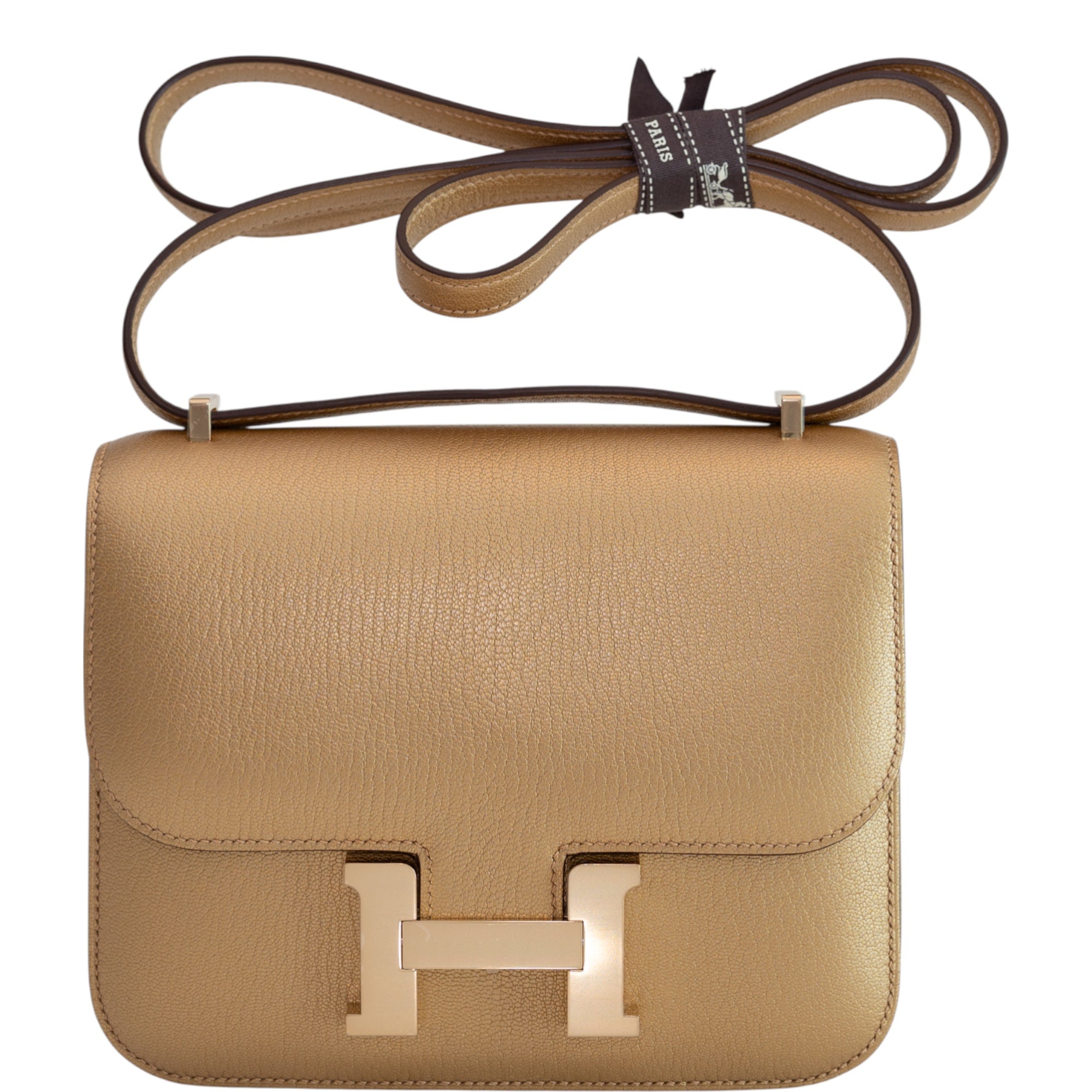
| Example | Width × height × depth | Fit detail |
|---|---|---|
| Mauve Sylvestre Chèvre Constance 18, 2022 | 18 × 15 × 5 cm 7.1 × 5.9 × 2.0 in |
Check the compartments, opening and strap of the specific generation. |
| Constance 24, historical Micro and Élan | Request the named version's measurements. | An elongated Élan is not simply a conventional Constance enlarged in every direction. |
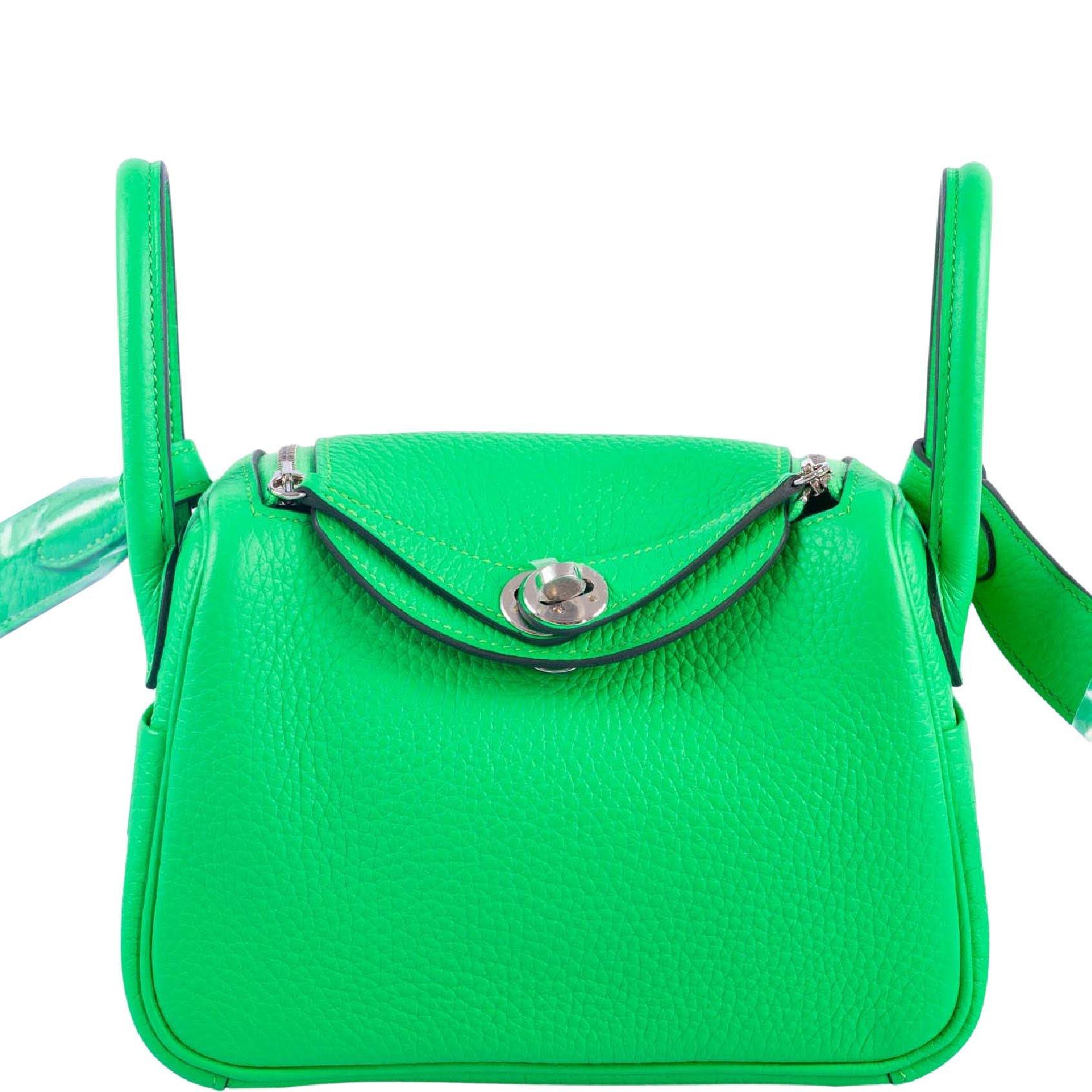
Hermès Lindy
The Lindy's handles sit on the gussets, changing how the body folds when lifted. The Mini's debut dates to 2019. Distinguish Mini and Mini II references from larger 26, 30 and 34 examples, and measure each strap rather than assuming the same crossbody fit.
| Reference | Width × height × depth | Additional information |
|---|---|---|
| Hermès Mini Lindy H079086CC89 | 19 × 13 × 9.5 cm 7.5 × 5.1 × 3.7 in |
Handle height 7.5 cm; strap length 108 cm. |
| Mini Lindy, 2019 | 19 × 12 × 9 cm 7.5 × 4.7 × 3.5 in |
A separate measured example, not a universal “20 cm” specification. |
Hermès Evelyne
Pocket layouts, straps and fittings vary by generation. An Evelyne III description should not be applied to every historical example or every TPM. Check lining, rear pocket, snap tab and strap adjustability separately.

Hermès Evelyne 16 Amazone H069426CCDD: 16 × 18 × 5.5 cm, approximately 6.3 × 7.1 × 2.2 inches. The cited strap measures 116 cm including snap hooks. This is strap length, not vertical strap drop.
For 29, 33 and larger historical formats, obtain the actual body's dimensions and the supplied strap specification. The number alone does not establish the pocket arrangement or shoulder position.
Hermès Garden Party
The family includes leather and canvas-and-leather versions with different linings and closures. It is not universally unlined or open without a fastener. Numeric model names are generally clearer than PM/MM abbreviations, which should be accompanied by measurements.
| Reference | Width × height × depth | Distinction |
|---|---|---|
| Hermès Neo Garden 23 | 23 × 16 × 10 cm 9.1 × 6.3 × 3.9 in |
A distinct compact interpretation. |
| Hermès Garden Party 30, Negonda | 30 × 21 × 13 cm 11.8 × 8.3 × 5.1 in |
The cited version has a snap closure, canvas lining and zipped interior pocket. |
| Country Garden Party 36, 2018 | 36 × 25 × 18 cm 14.2 × 9.8 × 7.1 in |
An auction example, not a specification for every Garden Party edition. |
Measure larger travel formats fully, including a realistic load. A model described as a travel bag is not automatically compliant with every airline's cabin-baggage rules.
How to choose a size
What you carry
Try the actual phone, wallet, glasses case or device through the opening. Confirm that the bag closes comfortably without forcing the flap.
How you carry it
Check handles over normal clothing and distinguish strap length from drop. Detachable does not necessarily mean adjustable.
Construction and weight
Compare with a realistic load. Leather, lining, hardware and construction can make two bags of the same width feel different.
Proportion
Use a mirror and photographs taken from a neutral distance. There is no universally correct bag size determined solely by the wearer's height.
Condition
Inspect handles, corners, base, closure and interior. Review repairs and included accessories alongside practical fit.
Price
Compare the actual configuration and current transaction terms. A smaller size is not a promise of appreciation or a quicker sale.
Keep the measurements of the acquired bag with its photographs and description. For model history and construction, continue to the Bag Models reference and the Birkin versus Kelly comparison.