Skip to content

Cart

Your cart is empty

Article: Hermès Ombre Lizard: Rarity, Species, Sizes, and Market Data

Hermès Ombre Lizard: Rarity, Species, Sizes, and Market Data

Hermès exotics are regarded as the height of the house's craft — unrivaled quality of materials matched by unrivaled quality of construction. While crocodile commands the highest retail prices, lizard bags are by far the rarest in production. Ombre Lizard represents the most demanding configuration within that already narrow category.

The house has used many different exotic skins to make their iconic handbags. While many — Beluga, Anteater, Elephant, Emu — were discontinued long ago, Hermès still produces bags from five exotic species: Ostrich, Porosus Saltwater Crocodile, Nile Crocodile (also called Nilo or Niloticus), Nile Monitor Lizard, and Asian Water Monitor, also known as Salvator Lizard. Porosus Crocodile bags retail for the highest price of all, but lizard bags are by far the rarest. So few lizard Birkins and Kellys are produced that it is difficult to pin down their current retail price. It's likely many Hermès boutiques go a year or more without receiving a lizard Birkin or Kelly from Paris.

Hermès Kelly 25 Sellier Black Lizard Gold Hardware

Production history and sizes

As long as Hermès has been making handbags, they have been making lizard bags as well. Auction records show Hermès lizard bags dating back to the first half of the 20th century, right around the time the maison changed the course of handbag design by adding a zipper closure to the Bolide. Lizard Kellys can be found dating to almost every decade the style has been produced, in every size from 15cm to 32cm — though almost always in Sellier construction. The first lizard Birkins did not appear until 2005, shortly after the introduction of the 25cm model around 2004. Since then, 25cm lizard Birkins and Kellys have been produced in a range of colors, some exclusive to this skin. They can be found with both Gold and Palladium hardware, and many early lizard bags from 2005 and 2006 carry the discontinued Ruthenium hardware.

When you think of lizards you probably picture small scaly animals that scamper under rocks — these are not the lizards Hermès uses. Monitor Lizards can grow to the size of a small crocodile, but they grow slowly and require very specific conditions. This is why the vast majority of lizard bags are 25cm or smaller. A handful of 30cm lizard bags have come through the secondary market in recent years, and vintage lizard Kellys can be found in 28cm and 32cm, but only one example of a 35cm lizard Birkin and one of a 40cm have appeared — both were unique special order pieces.

Understanding the species

Most lizard bags are produced in Varanus Niloticus, or Nilo Lizard, which is prized for its small, even scales and is buffed to a high-gloss finish that creates a near-glittering effect. These bags are marked with a single dash next to the Hermès logo. Some bags carry a double dash, indicating Salvator Lizard. While Ombre Lizard bags are done in Salvator and buffed to a sheen, most Salvator bags are treated with a matte finish that accentuates the texture of the scales.

Ombre Lizard: the construction challenge

Ombre Lizard bags showcase the natural coloring of the animal, but also require painstaking work to perfect — and are subject to even higher quality standards than standard lizard production.

The most desirable color is Ombre, which moves from gray on the sides to nearly white at the center, sprinkled with the natural gray rings that give these lizards their distinct pattern. Considered by many collectors as equal in desirability to the Himalayan, Ombre Lizard bags showcase the natural coloring of the animal but require painstaking work to achieve. Not only do the scales have to be perfect and the skins free of blemishes — the pattern has to be distinct and symmetrical, and Hermès must find two matching skins. These have been produced sporadically since the mid-2000s. Early examples that have not been carefully maintained show yellowing. Some collectors value this patina; for others it drives demand toward the newest and cleanest examples.
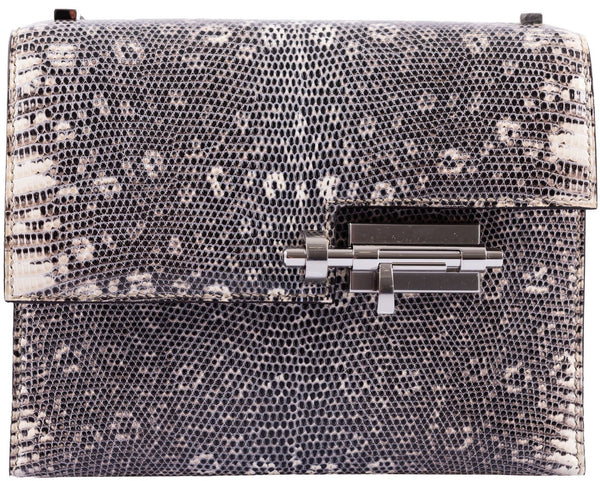
Hermès Verrou Chain Ombre Lizard Palladium Hardware

Secondary market performance

Annual appreciation: Lizard Birkins and Kellys have risen approximately 13% annually on average over the past decade.

25cm Lizard Birkin: Average price around $30,000

20cm Lizard Kelly: Stable around $25,000

25cm Lizard Kelly: Ranged up to $48,000 (Fuchsia record, 2024)

30cm Lizard Birkin: Averaging $65,000 (extremely rare; sparse transaction record)

Ombre Lizard makes the rarity premium visible in the numbers. 25cm Ombre Lizard Birkins average $53,000 overall at auction and $79,000 across the three that sold in the most recent year of data. 25cm Ombre Lizard Kellys average $67,000 overall, with one selling for $110,000 in 2019 — which did not beat the $120,000 record set for an Ombre Lizard Kelly in 2017. The record for an Ombre Lizard Birkin at auction is nearly $98,000. These figures support the conclusion that lizard Birkins and Kellys are among the most genuinely scarce configurations in the Hermès secondary market, and that collector demand is continuing to increase as more buyers understand what they represent.

Ombre Lizard Kellys have reached $120,000 at auction — a price point that places them in the same demand tier as the Himalayan for buyers who understand the production constraints.

JaneFinds is not affiliated with Hermès.
Leave a comment

This site is protected by hCaptcha and the hCaptcha Privacy Policy and Terms of Service apply.

All comments are moderated before being published.

Read more

Hermès Mini Kelly Mania

The Mini Kelly: A Complete History from 1980 to the Mini Kelly II

The full generational arc of the Hermès Mini Kelly — the 20cm original (1980–2006), its four construction types, rare material variants, and the Mini Kelly II released in 2016. With auction data an...

Read more
Hermès Metallic Bags: History, 2005 Chèvre Release & Collector Guide

Hermès Metallic Bags: History, 2005 Chèvre Release & Collector Guide

The definitive Hermès Metallics reference — Leïla Menchari's window origins, the ultra-limited 2005 Chèvre release in Gold, Silver, and Bronze, window one-offs, care, and collector intelligence.

Read more
JANEFINDS STAFF
4 min read

Hermès Ombre Lizard: Rarity, Species, Sizes, and Market Data

Discover the rare world of Hermès Lizard bags—from Ombre masterpieces to elusive Kellys and Birkins. A collector’s guide to rarity, history, and market value.

Lessons on Hermès Lizard

Hermès Ombre Lizard: Rarity, Species, Sizes, and Market Data

Hermès exotics are regarded as the height of the house's craft — unrivaled quality of materials matched by unrivaled quality of construction. While crocodile commands the highest retail prices, lizard bags are by far the rarest in production. Ombre Lizard represents the most demanding configuration within that already narrow category.

The house has used many different exotic skins to make their iconic handbags. While many — Beluga, Anteater, Elephant, Emu — were discontinued long ago, Hermès still produces bags from five exotic species: Ostrich, Porosus Saltwater Crocodile, Nile Crocodile (also called Nilo or Niloticus), Nile Monitor Lizard, and Asian Water Monitor, also known as Salvator Lizard. Porosus Crocodile bags retail for the highest price of all, but lizard bags are by far the rarest. So few lizard Birkins and Kellys are produced that it is difficult to pin down their current retail price. It's likely many Hermès boutiques go a year or more without receiving a lizard Birkin or Kelly from Paris.

Hermès Kelly 25 Sellier Black Lizard Gold Hardware

Production history and sizes

As long as Hermès has been making handbags, they have been making lizard bags as well. Auction records show Hermès lizard bags dating back to the first half of the 20th century, right around the time the maison changed the course of handbag design by adding a zipper closure to the Bolide. Lizard Kellys can be found dating to almost every decade the style has been produced, in every size from 15cm to 32cm — though almost always in Sellier construction. The first lizard Birkins did not appear until 2005, shortly after the introduction of the 25cm model around 2004. Since then, 25cm lizard Birkins and Kellys have been produced in a range of colors, some exclusive to this skin. They can be found with both Gold and Palladium hardware, and many early lizard bags from 2005 and 2006 carry the discontinued Ruthenium hardware.

When you think of lizards you probably picture small scaly animals that scamper under rocks — these are not the lizards Hermès uses. Monitor Lizards can grow to the size of a small crocodile, but they grow slowly and require very specific conditions. This is why the vast majority of lizard bags are 25cm or smaller. A handful of 30cm lizard bags have come through the secondary market in recent years, and vintage lizard Kellys can be found in 28cm and 32cm, but only one example of a 35cm lizard Birkin and one of a 40cm have appeared — both were unique special order pieces.

Understanding the species

Most lizard bags are produced in Varanus Niloticus, or Nilo Lizard, which is prized for its small, even scales and is buffed to a high-gloss finish that creates a near-glittering effect. These bags are marked with a single dash next to the Hermès logo. Some bags carry a double dash, indicating Salvator Lizard. While Ombre Lizard bags are done in Salvator and buffed to a sheen, most Salvator bags are treated with a matte finish that accentuates the texture of the scales.

Ombre Lizard: the construction challenge

Ombre Lizard bags showcase the natural coloring of the animal, but also require painstaking work to perfect — and are subject to even higher quality standards than standard lizard production.

The most desirable color is Ombre, which moves from gray on the sides to nearly white at the center, sprinkled with the natural gray rings that give these lizards their distinct pattern. Considered by many collectors as equal in desirability to the Himalayan, Ombre Lizard bags showcase the natural coloring of the animal but require painstaking work to achieve. Not only do the scales have to be perfect and the skins free of blemishes — the pattern has to be distinct and symmetrical, and Hermès must find two matching skins. These have been produced sporadically since the mid-2000s. Early examples that have not been carefully maintained show yellowing. Some collectors value this patina; for others it drives demand toward the newest and cleanest examples.

Hermès Verrou Chain Ombre Lizard Palladium Hardware

Secondary market performance

Annual appreciation: Lizard Birkins and Kellys have risen approximately 13% annually on average over the past decade.

25cm Lizard Birkin: Average price around $30,000

20cm Lizard Kelly: Stable around $25,000

25cm Lizard Kelly: Ranged up to $48,000 (Fuchsia record, 2024)

30cm Lizard Birkin: Averaging $65,000 (extremely rare; sparse transaction record)

Ombre Lizard makes the rarity premium visible in the numbers. 25cm Ombre Lizard Birkins average $53,000 overall at auction and $79,000 across the three that sold in the most recent year of data. 25cm Ombre Lizard Kellys average $67,000 overall, with one selling for $110,000 in 2019 — which did not beat the $120,000 record set for an Ombre Lizard Kelly in 2017. The record for an Ombre Lizard Birkin at auction is nearly $98,000. These figures support the conclusion that lizard Birkins and Kellys are among the most genuinely scarce configurations in the Hermès secondary market, and that collector demand is continuing to increase as more buyers understand what they represent.

Ombre Lizard Kellys have reached $120,000 at auction — a price point that places them in the same demand tier as the Himalayan for buyers who understand the production constraints.

JaneFinds is not affiliated with Hermès.