Skip to content

Cart

Your cart is empty

Article: How to Authenticate a Hermès Bag: The Complete Collector's Reference

The JaneFinds Archive

How to Authenticate a Hermès Bag

The complete collector's reference — leather, stitching, stamps, hardware, exotics, and the markers that matter

Hermès bag authentication reference — JaneFinds

The Hermès secondary market is one of the most actively counterfeited luxury markets in the world. Pieces that closely mimic authentic examples are produced at every price point and configuration — including formats that were once considered too complex or low-volume to counterfeit profitably. The markers described below are based on 30 years of hands-on authentication experience. They are a starting point, not a replacement for expert evaluation on high-value transactions.

Authentication is not a checklist. It is a synthesis of multiple signals evaluated against each other and against the specific production history of the piece in question. A single marker can be misleading; the full picture rarely is. What follows is organized by category so you can approach each element systematically — but the final assessment requires holding all of them simultaneously.

Walk away immediately if you see any of these

Dust bag with printed (not stitched) Hermès branding.

Hardware that feels lightweight or shows uneven plating at edges or corners.

Stitching that is machine-uniform, uses synthetic thread, or shows inconsistent angles — Hermès uses waxed linen, hand-pulled.

Date stamp that is crooked, too deep, too faint, or in an incorrect position for the claimed year and model.

Hermès Paris stamp with thin, inconsistent, or poorly embossed letterforms.

Lock and key numbers that do not match each other.

A price that appears significantly below market — if it seems too favorable, it is.

A seller who cannot provide detailed photographs of all key authentication points on request.

Leather quality

Hermès' leather selection process begins at the tannery level — hides are rejected at rates that no mass-market producer would tolerate. The result is leather that behaves differently from counterfeits in ways that are perceptible in hand but difficult to photograph convincingly. This is why in-person evaluation remains the standard for serious authentication.

Standard leathers — what authentic looks and feels like

Togo

Fine pebbled grain, fully matte. The grain is natural — it varies in density across the hide, concentrating slightly at natural creasing points. Machine-embossed counterfeit Togo has grain that is too uniform, too evenly distributed, with no variation. The surface should feel supple with subtle resistance, not soft-plastic. Natural veining is expected and indicates genuine hide.

Clemence

Larger grain than Togo, heavier, with more pronounced slouch. Authentic Clemence has a visible depth to the grain — individual pebbles cast micro-shadows at raking light. Counterfeit Clemence tends to look flat under the same light. The weight of a Clemence Birkin 30 is perceptible — lightweight for its apparent size is a red flag.

Epsom

Embossed crosshatch pattern — the only standard Hermès leather where the surface texture is applied rather than natural. Because of this, Epsom is the most frequently counterfeited successfully at the surface level. The key differentiator is rigidity: authentic Epsom holds its shape under any angle; counterfeit versions soften at corners or show compression creasing where genuine Epsom would not.

Box Calf

High-gloss smooth calfskin. Authentic Box has a depth to its shine — the surface has dimension. Counterfeit Box is typically lacquered rather than polished, producing a flat, reflective surface without depth. Box scratches visibly on genuine pieces; those scratches should show the underlying leather, not a base coat. Vintage Box (pre-2000) develops a patina that is distinctive and essentially impossible to replicate.

Swift

Fine grain, semi-matte, smooth. Very close to genuine quality in counterfeit production, which is why Swift is now one of the more commonly counterfeited leathers successfully. The key differentiator is edge finishing — authentic Swift edges are painted with a precise coating that is flush with the leather surface. Counterfeit Swift edges frequently show excess edge paint, uneven application, or raw edge exposure.

Evercolor

Introduced approximately 2013. Extremely fine grain, fully matte, more consistent surface than Togo. Rarely counterfeited convincingly because it is a newer leather with a distinct hand feel that requires proper sourcing to replicate. If a bag is labeled Evercolor but the grain is coarser than Epsom, it is not Evercolor.

Scent

Authentic Hermès leather has a distinctive natural leather scent — rich, slightly earthy, with none of the chemical or synthetic odor that most counterfeits carry. The scent is a function of Hermès' tanning process, which uses specific chemical protocols. This is a useful quick indicator but is not sufficient on its own — some high-quality counterfeits are treated to simulate the scent.

Natural variation

Minor natural variation is a positive indicator. Subtle creasing, slight color variation across a panel, and minor grain density differences are hallmarks of genuine hide. Counterfeits frequently show an unrealistic uniformity because they are produced from processed or embossed materials that eliminate natural variation. This matters most in Box Calf and Barenia, where natural patina variation is part of the material's identity.

Hermès Birkin 35 Black Veau Doblis Suede Black Porosus Crocodile Gold Hardware
Birkin 35 — Black Veau Doblis Suede body with Black Porosus Crocodile center panel, Gold Hardware. The contrast between the matte suede and the scaled crocodile illustrates how dramatically different legitimate Hermès materials behave under the same light.

Stitching

Hermès uses saddle stitching — a two-needle technique where each stitch passes through the leather simultaneously from both sides, creating an interlocked thread structure that is significantly stronger than machine stitching. Because each stitch is hand-tensioned, there is a slight but consistent variation in angle and depth that machine stitching cannot replicate.

What authentic saddle stitching looks like

  • Angle: Each stitch is set at approximately 45 degrees, consistently maintained across the seam. The angle is the result of the hand-stitching posture and does not vary significantly within a single seam.
  • Spacing: 3–4mm between stitches, depending on the leather and the specific section of the bag. Spacing is consistent but not machine-perfect — there will be minor variation of less than 0.5mm.
  • Thread: Waxed linen. The wax gives it a slight sheen different from polyester or nylon. It does not fray visibly at cut ends. Color matches or deliberately contrasts with the leather — both are intentional.
  • Tension: Each stitch is pulled to the same tension. The thread sits flush with or very slightly below the leather surface — it does not sit proud of the surface, which would indicate machine over-tensioning.
  • End finishing: The ends of seams are finished by passing the thread back through previous stitches and trimming flush. There are no loose threads, knots visible on the exterior, or fraying.

Key areas to examine closely

  • Handle base: Where the handle attaches to the body. This is a high-stress point and Hermès reinforces it with additional stitching passes. Missing reinforcement or uneven stitching at the base is a significant red flag.
  • Corners: Stitching must follow the corner geometry precisely. Counterfeit stitching frequently breaks down at corners — stitches bunch, spacing changes, or the angle shifts.
  • Interior: Hermès stitches the interior with the same consistency as the exterior. The interior is less visible but is evaluated by the same craftsperson. Poor interior stitching on an otherwise convincing exterior is a reliable authentication signal.
  • Clochette: The leather key cover. Stitching should be tight, consistent, and match the quality of the main bag seams.

The imperfection test: Authentic Hermès stitching has minor natural variation — it is not machine-perfect. However, that variation is subtle and consistent in character. Counterfeit bags show a different kind of imperfection: irregular spacing, changing angles, or thread quality variation within a single seam. The difference between "hand-made with slight natural variation" and "poorly executed machine stitching" is perceptible once you have examined genuine examples.

Logo and date stamp

The Hermès blind stamp — the date and artisan mark pressed into the leather — is one of the most information-dense authentication elements on the bag. It tells you when the bag was made, which production era it belongs to, and whether it was a Special Order. It is also one of the most frequently faked elements, and one of the most reliably distinguishable from a genuine impression when examined closely.

The Hermès Paris stamp

Embossed on the exterior of the bag, typically on the front face near the top, or on the closure strap. Key elements:

  • Font: The typeface Hermès uses for its logo stamp has been consistent for decades. It is a specific serif font with distinctive proportions — the H is wider than it appears on most sans-serif interpretations, and the accented É has a specific accent angle. Counterfeit stamps frequently use fonts that approximate but don't match the genuine typeface.
  • Impression depth: The stamp is pressed to a consistent depth — enough to be clearly legible, not so deep that it distorts the surrounding leather. Over-impressed stamps (too deep, with leather raised around the edges of the letters) and under-impressed stamps (barely visible) are both red flags.
  • Spacing and alignment: Letters are evenly spaced and horizontally aligned. The É accent is precisely positioned. Misaligned, tilted, or unevenly spaced stampings are significant red flags.
  • Location: On Birkins, the main stamp is typically on the back of the closure strap. On Kellys, it is typically inside the bag on the right-hand panel. Location has varied over production eras — verify against known authentic examples for the specific model and year.

The date stamp

The date stamp is pressed separately from the Hermès Paris logo. It consists of a single letter (the year code) inside a shape (or without a shape, depending on the era), along with the artisan identification number. Both elements are present on genuine pieces. Missing either element — or having one without the other — requires explanation.

Era Years Format Example
Vintage 1945–1970 Plain letter, no shape A (1945), Z (1970)
Circle era 1971–1996 Letter inside circle ○A (1971), ○Z (1996)
Square era 1997–2014 Letter inside square □A (1997), □R (2014)
Modern era 2015–present Plain letter, no shape T (2015), G (2026)

The modern era sequence is non-alphabetical: T/2015, X/2016, A/2017, C/2018, D/2019, Y/2020, Z/2021, U/2022, B/2023, W/2024, K/2025, G/2026. A bag claiming to be from 2020 should show a Y stamp, not any other letter. If the claimed year doesn't match the letter, the provenance is unreliable. For a full visual reference, see the JaneFinds Date Stamp Guide.

Hermès HAC Birkin 55 Toile Rouge H Box Gold Hardware 1981 K Circle stamp
HAC Birkin 55 — Toile & Rouge H Box Calf, Gold Hardware (1981, K Circle). Circle-era stamps sit inside a pressed ring; the K letter here dates to 1981 in the Circle sequence.
Hermès Kelly 32 Retourne Himalayan Niloticus Crocodile Palladium Hardware
Kelly 32 Retourne — Himalayan Niloticus Crocodile, Palladium Hardware. Modern-era Himalayans carry plain blind stamps without a surrounding shape; the letter must correspond to the correct production year.

Special marks

  • Horseshoe (HSS): Indicates a Special Order — a bag made to a client's custom specifications. This mark is pressed separately from the date stamp and appears in addition to it, not in place of it. HSS pieces without a date stamp are incomplete.
  • Star / shooting star: Indicates a bag made as a gift for an Hermès craftsperson. Rarely encountered; not commercially available as a standard production item.
  • Artisan ID: A number pressed near the date stamp, identifying the specific craftsperson. This number should be clearly legible and consistently impressed alongside the year letter.

Hardware

Hermès hardware is cast from solid metal — palladium-plated brass (PHW), gold-plated brass (GHW), or 18K white gold in Exceptional Collection pieces. The weight is perceptible and is the most immediate hardware authentication signal. Counterfeit hardware is consistently lightweight because it is produced from cheaper alloys; the weight difference between genuine and counterfeit hardware is not subtle.

Turn-lock touret

  • The turn-lock mechanism should operate smoothly and with resistance appropriate to the hardware weight. It should not wobble when engaged. Counterfeit turn-locks frequently have play in the mechanism that genuine hardware does not.
  • The engraving on the touret — HERMÈS PARIS on the front face — should be crisp, evenly deep, and in the correct typeface. Examine under direct light at a slight angle to assess impression quality.
  • The back of the touret should show clean casting without visible mold seams or rough finishing. Hermès polishes all surfaces of its hardware including those not normally visible.

Lock (Cadena) and keys

  • Matching numbers: The number engraved on the lock must match the number engraved on both keys. This is a production requirement, not a later addition. Non-matching numbers indicate either a replacement lock, replacement keys, or a counterfeit. Replacement locks and keys do exist legitimately on older bags — but they should be documented.
  • Lock engraving: HERMÈS is engraved on the bottom face of the lock. The engraving depth and typeface are consistent across genuine locks; shallow or irregular engraving is a red flag.
  • Key construction: Genuine Hermès keys are solid, with clean casting and consistent finish on all surfaces. The hollow back of counterfeit keys is often visible on examination.
  • Lock mechanism: A genuine lock engages and releases cleanly with the correct key. The mechanism should feel precise, not sticky or loose. Counterfeit locks frequently have mechanism play that is noticeable in use.

Clochette

  • The clochette — the leather key cover — is constructed from a single piece of leather folded in half and stitched along one edge. Two separate pieces seamed together indicate a non-genuine clochette.
  • The leather should match the quality and finish of the bag's leather, or be a deliberate contrast material as specified in the bag's production. A clochette in degraded or mismatched leather on an otherwise fine bag is a provenance question.
  • The stitching on the clochette follows the same standards as the main bag: consistent angle, spacing, and thread quality.

Zipper (on bags with zip pockets)

  • Hermès uses YKK zippers in most configurations — the YKK marking on the zipper pull is an authenticity indicator. The metal should have a matte finish consistent with the bag's hardware finish.
  • The zipper operates smoothly without resistance or catching. The pull should lie parallel to the zipper line when closed.
  • On newer models, the zipper pull carries an H detail or the Hermès name — examine this closely for font accuracy and impression quality.

Exotic skin authentication

Exotic skin authentication requires a separate set of criteria from standard leather. The counterfeiting of exotics — particularly Niloticus Crocodile and Porosus Crocodile — has become significantly more sophisticated. The scale pattern on genuine exotic skin cannot be replicated by embossing; the individual scales on genuine crocodile are three-dimensional and cast distinct shadows at raking light. Embossed counterfeit "crocodile" is flat under the same light, however convincing it appears under direct overhead illumination.

Hermès HAC Birkin 40 Black Matte Porosus Crocodile Palladium Hardware
HAC Birkin 40 — Black Matte Porosus Crocodile, Palladium Hardware. Genuine Porosus scales show individual three-dimensional relief; scale size decreases visibly toward the edges of the panel.
Hermès Kelly 28 Sellier Black Doblis Suede Gold Hardware
Kelly 28 Sellier — Black Veau Doblis Suede, Gold Hardware. Doblis suede authentication depends on the uniformity and density of the nap — genuine Doblis is markedly more consistent than any suede counterfeit.

Crocodile — Niloticus vs. Porosus

  • Scale size: Niloticus (Nile crocodile) has larger, more irregular scale patterns. Porosus (saltwater crocodile) has smaller, more refined and symmetrical scales. Both are three-dimensional on genuine skins; both are flat on embossed counterfeits.
  • Pore marks: Genuine crocodile skin has small follicle marks visible within the scales under close examination. These are not present on embossed leather.
  • Scale variation: Scales on genuine crocodile skin vary naturally in size across the panel — smaller at the edges, larger at the center. This natural distribution cannot be replicated uniformly.
  • Finish: Matte finish on genuine crocodile has a natural depth — the surface absorbs light rather than reflecting it uniformly. Shiny (Lisse) finish has a depth to its reflection that differs from the surface lacquer applied to counterfeit "shiny crocodile."
  • Himalayan gradient: The Himalayan gradient — white to gray — is achieved through controlled dye application to genuine Niloticus skin. The gradient transitions smoothly and the scale coloration varies within individual scales, not just between them. Counterfeit Himalayan usually applies color to an embossed surface, producing a gradient without intra-scale variation.

Ostrich

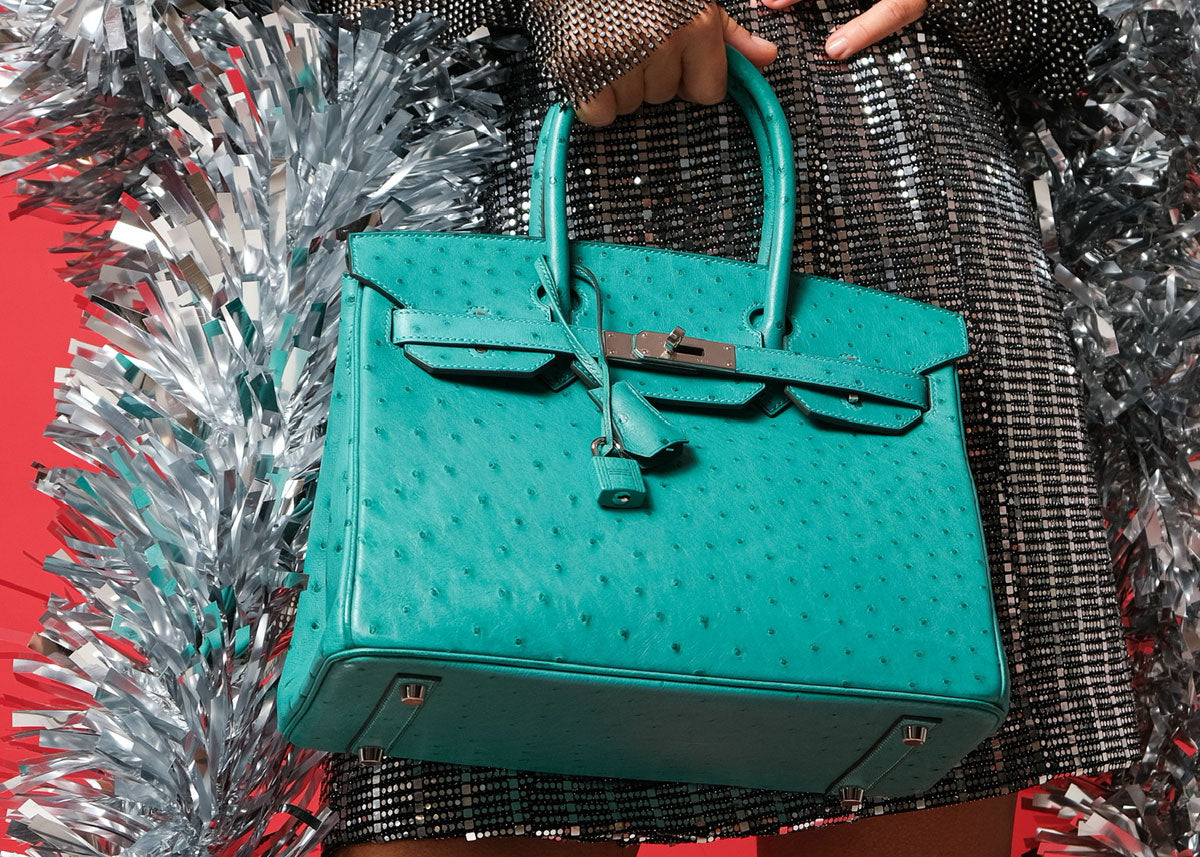
  • Genuine ostrich follicle bumps — the quill marks — are three-dimensional and vary in height and spacing across the panel. They cast shadows under raking light. Embossed ostrich is flat.
  • The areas between follicle bumps on genuine ostrich have a smooth, fine-grained texture. Embossed versions typically show a rough or matte field between the raised bumps.
  • Genuine ostrich is supple — it moves with the bag's structure. Embossed "ostrich" on a rigid base does not have the same drape.

Lizard

  • Genuine lizard scales are very small and uniform but not perfectly regular — there is natural variation in scale edge definition across the panel. Counterfeit lizard embossing is too regular.
  • Ombré Lizard has a gradient applied to genuine lizard skin; the color penetrates into the scale structure. Color applied to an embossed surface sits on top of the scale pattern and behaves differently at edges and corners.
  • Lizard is fragile — the scale edges on worn counterfeit lizard frequently lift or crack at stress points in ways that differ from how genuine lizard ages.

Dust bag

The Hermès dust bag is often the first thing a buyer handles and frequently the first element a counterfeit attempts to replicate. Genuine dust bags have specific material, construction, and marking characteristics that are consistently executed and reliably distinguishable from counterfeits.

Material

Genuine Hermès dust bags are made from substantial cotton flannel or heavy cotton canvas — the material feels soft, dense, and substantial. Counterfeit dust bags are frequently thinner, lighter, and have a slightly different surface texture that becomes obvious when held alongside a genuine example.

Color and markings

  • Primary colors are light beige (with dark brown Hermès logo) and orange (with lighter logo). Other colors are not standard current production.
  • The Hermès logo on the dust bag is stitched, not printed. This is one of the clearest and most immediately verifiable authentication signals on the dust bag. Run your fingertip across the logo — genuine logos have raised thread texture. Printed logos are flat.
  • Logo font and spacing match the standard Hermès typeface used on bags and hardware. Blurry, inconsistently spaced, or font-mismatched logos indicate a counterfeit dust bag.

Construction

  • Seams are tightly stitched with a high stitch count — the dust bag is not an afterthought but a finished product. Loose threads, uneven seams, or raw edges inside the dust bag are red flags.
  • The drawstring closure should operate smoothly; the cord should be even in diameter and consistent in material throughout its length.

A note on missing dust bags: The absence of a dust bag does not indicate a counterfeit bag. Many genuine bags are sold without original accessories — particularly older examples and pieces from estate or auction sources. The presence of a dust bag adds value and provenance, but its absence is not authentication evidence either way.

Where to find stamps and marks by model

Model Hermès Paris stamp Date stamp location Notes
Birkin Front face of closure strap, below hardware Back of closure strap (older); interior left panel (post-2015) Artisan ID directly beside or below date letter
Kelly Front of exterior flap Interior right panel (older); may migrate to interior left post-2015 On Sellier, stamp placement is slightly higher on the flap than on Retourne
Constance Interior, on the leather panel behind the H clasp Interior, adjacent to Hermès Paris stamp Smaller stamp size than Birkin/Kelly standard
Lindy Interior lining, central panel Adjacent to main stamp on interior panel Sometimes on the interior leather trim rather than lining
Bolide Interior, on the leather interior panel Adjacent to main stamp Older Bolides may carry stamps in different interior locations
Kelly Pochette Interior, on interior leather panel Interior, adjacent to main stamp Smaller format — stamps are more compressed in size

Authentication checklist by category

Leather

  • Natural grain variation present (not machine-uniform)
  • Correct leather type for claimed model and year
  • Natural scent — earthy, not chemical
  • Supple hand feel, not stiff or plasticky
  • Edge finishing is flush and painted consistently
  • Aging (if vintage) consistent with claimed leather type

Stitching

  • Consistent 45° angle throughout each seam
  • 3–4mm stitch spacing, hand-variation only
  • Waxed linen thread (not synthetic)
  • Double reinforcement at handle base
  • Interior stitching matches exterior quality
  • No loose threads, fraying, or visible knots

Stamps and logo

  • Hermès Paris stamp — correct typeface and impression depth
  • Date stamp letter matches claimed production year
  • Stamp era format correct (circle/square/plain)
  • Artisan ID present alongside date letter
  • Stamp position correct for model and era
  • HSS mark present if claimed as Special Order

Hardware

  • Substantial weight — not lightweight alloy
  • HERMÈS PARIS engraving — crisp, correct font
  • Lock number matches key number(s)
  • Turn-lock operates smoothly, no wobble
  • Clochette from single folded piece of leather
  • Zipper (if present) moves without resistance

Exotic skins (if applicable)

  • Scale pattern is three-dimensional under raking light
  • Natural scale size variation across panel
  • Follicle marks visible within scales (crocodile)
  • Follicle bumps are three-dimensional (ostrich)
  • Gradient penetrates into scale structure (Himalayan, Ombré)
  • Skin is supple, not mounted on rigid embossed base

Dust bag and accessories

  • Logo is stitched, not printed
  • Heavy cotton canvas — substantial weight
  • Correct color (beige or orange — not other colors)
  • Seams tightly stitched, no raw edges
  • Original box matches claimed bag model if present
  • Receipt and authentication card (adds value, not required)

When professional authentication is required

Surface examination is adequate for identifying the most common counterfeit markers on pieces in the $5,000–$15,000 range. Above that threshold, and for any exotic skin piece regardless of price, professional authentication is standard practice. The reasons are practical:

  • Counterfeit sophistication scales with price. A $50,000 fake receives more investment in convincing execution than a $5,000 fake. The markers that reliably identify inexpensive counterfeits may not reliably identify well-funded ones.
  • Exotic skin authentication requires reference collections. Distinguishing genuine Porosus from high-quality embossed leather requires comparison against documented genuine examples. Professional authenticators maintain these references; buyers generally do not.
  • Provenance documentation matters for resale. Professional authentication creates a paper trail that supports future sale. An authenticated piece with documentation is more liquid than an equivalent piece without it.
  • Edge cases require judgment, not checklists. Transitional-era stamps (late Square era to modern), unusual configurations, and Special Order pieces do not always conform to standard expectations. Professional authenticators are equipped to evaluate these cases; a checklist is not.

JaneFinds authenticates every piece in its collection before listing, drawing on Jane Angert's 30 years of Hermès authentication expertise — the same expertise that auction houses consult on attribution questions. For buyers sourcing from other channels, request documentation of the seller's authentication process and credentials before committing on any piece above $10,000.

Hermès Birkin 30 Candy Collection Rose Tyrien Chèvre Palladium Hardware
Birkin 30 Candy Collection — Rose Tyrien Epsom with Rubis Chèvre interior, Palladium Hardware. Candy Collection authentication requires verifying the contrast color in two specific locations: the full interior lining and the reverse of the sangle straps. Both must match the interior color, not the exterior.

The single most reliable rule: Buy from authenticated sources. Every authentication marker described in this guide exists to help you evaluate pieces from sellers whose authentication process you cannot verify. When you buy from a source with 30 years of documented authentication expertise, you are not buying a bag and then authenticating it — the authentication is part of what you are acquiring. The secondary market's authentication infrastructure only works when buyers consistently demand it.
Leave a comment

This site is protected by hCaptcha and the hCaptcha Privacy Policy and Terms of Service apply.

All comments are moderated before being published.

Read more

The Hermès Birkin Bag Lawsuit

The Hermès Birkin Antitrust Lawsuit: What It Was, What the Court Decided, and What It Means for Buyers

A full account of the Cavalleri v. Hermès antitrust case — what the plaintiffs alleged, how the boutique allocation system actually works, why the court dismissed the case, and what it means for se...

Read more
How to Wear an Hermès Scarf

How to Wear a Hermès Scarf: Styling and Reference Guide

A practical reference to Hermès scarves — formats, how to wear them, care requirements, and the Twilly's specific role as a handle protector. From JaneFinds.

Read more
Ross Angert
19 min read

How to Authenticate a Hermès Bag: The Complete Collector's Reference

he definitive guide to authenticating Hermès Birkin and Kelly bags — leather, stitching, date stamps, hardware, exotic skins, dust bags, and the markers that professional authenticators use. From JaneFinds, with 30 years of expertise.

How Do I Know If My Hermès Bag Is Authentic?
The JaneFinds Archive

How to Authenticate a Hermès Bag

The complete collector's reference — leather, stitching, stamps, hardware, exotics, and the markers that matter

Hermès bag authentication reference — JaneFinds

The Hermès secondary market is one of the most actively counterfeited luxury markets in the world. Pieces that closely mimic authentic examples are produced at every price point and configuration — including formats that were once considered too complex or low-volume to counterfeit profitably. The markers described below are based on 30 years of hands-on authentication experience. They are a starting point, not a replacement for expert evaluation on high-value transactions.

Authentication is not a checklist. It is a synthesis of multiple signals evaluated against each other and against the specific production history of the piece in question. A single marker can be misleading; the full picture rarely is. What follows is organized by category so you can approach each element systematically — but the final assessment requires holding all of them simultaneously.

Walk away immediately if you see any of these

Dust bag with printed (not stitched) Hermès branding.

Hardware that feels lightweight or shows uneven plating at edges or corners.

Stitching that is machine-uniform, uses synthetic thread, or shows inconsistent angles — Hermès uses waxed linen, hand-pulled.

Date stamp that is crooked, too deep, too faint, or in an incorrect position for the claimed year and model.

Hermès Paris stamp with thin, inconsistent, or poorly embossed letterforms.

Lock and key numbers that do not match each other.

A price that appears significantly below market — if it seems too favorable, it is.

A seller who cannot provide detailed photographs of all key authentication points on request.

Leather quality

Hermès' leather selection process begins at the tannery level — hides are rejected at rates that no mass-market producer would tolerate. The result is leather that behaves differently from counterfeits in ways that are perceptible in hand but difficult to photograph convincingly. This is why in-person evaluation remains the standard for serious authentication.

Standard leathers — what authentic looks and feels like

Togo

Fine pebbled grain, fully matte. The grain is natural — it varies in density across the hide, concentrating slightly at natural creasing points. Machine-embossed counterfeit Togo has grain that is too uniform, too evenly distributed, with no variation. The surface should feel supple with subtle resistance, not soft-plastic. Natural veining is expected and indicates genuine hide.

Clemence

Larger grain than Togo, heavier, with more pronounced slouch. Authentic Clemence has a visible depth to the grain — individual pebbles cast micro-shadows at raking light. Counterfeit Clemence tends to look flat under the same light. The weight of a Clemence Birkin 30 is perceptible — lightweight for its apparent size is a red flag.

Epsom

Embossed crosshatch pattern — the only standard Hermès leather where the surface texture is applied rather than natural. Because of this, Epsom is the most frequently counterfeited successfully at the surface level. The key differentiator is rigidity: authentic Epsom holds its shape under any angle; counterfeit versions soften at corners or show compression creasing where genuine Epsom would not.

Box Calf

High-gloss smooth calfskin. Authentic Box has a depth to its shine — the surface has dimension. Counterfeit Box is typically lacquered rather than polished, producing a flat, reflective surface without depth. Box scratches visibly on genuine pieces; those scratches should show the underlying leather, not a base coat. Vintage Box (pre-2000) develops a patina that is distinctive and essentially impossible to replicate.

Swift

Fine grain, semi-matte, smooth. Very close to genuine quality in counterfeit production, which is why Swift is now one of the more commonly counterfeited leathers successfully. The key differentiator is edge finishing — authentic Swift edges are painted with a precise coating that is flush with the leather surface. Counterfeit Swift edges frequently show excess edge paint, uneven application, or raw edge exposure.

Evercolor

Introduced approximately 2013. Extremely fine grain, fully matte, more consistent surface than Togo. Rarely counterfeited convincingly because it is a newer leather with a distinct hand feel that requires proper sourcing to replicate. If a bag is labeled Evercolor but the grain is coarser than Epsom, it is not Evercolor.

Scent

Authentic Hermès leather has a distinctive natural leather scent — rich, slightly earthy, with none of the chemical or synthetic odor that most counterfeits carry. The scent is a function of Hermès' tanning process, which uses specific chemical protocols. This is a useful quick indicator but is not sufficient on its own — some high-quality counterfeits are treated to simulate the scent.

Natural variation

Minor natural variation is a positive indicator. Subtle creasing, slight color variation across a panel, and minor grain density differences are hallmarks of genuine hide. Counterfeits frequently show an unrealistic uniformity because they are produced from processed or embossed materials that eliminate natural variation. This matters most in Box Calf and Barenia, where natural patina variation is part of the material's identity.

Hermès Birkin 35 Black Veau Doblis Suede Black Porosus Crocodile Gold Hardware
Birkin 35 — Black Veau Doblis Suede body with Black Porosus Crocodile center panel, Gold Hardware. The contrast between the matte suede and the scaled crocodile illustrates how dramatically different legitimate Hermès materials behave under the same light.

Stitching

Hermès uses saddle stitching — a two-needle technique where each stitch passes through the leather simultaneously from both sides, creating an interlocked thread structure that is significantly stronger than machine stitching. Because each stitch is hand-tensioned, there is a slight but consistent variation in angle and depth that machine stitching cannot replicate.

What authentic saddle stitching looks like

  • Angle: Each stitch is set at approximately 45 degrees, consistently maintained across the seam. The angle is the result of the hand-stitching posture and does not vary significantly within a single seam.
  • Spacing: 3–4mm between stitches, depending on the leather and the specific section of the bag. Spacing is consistent but not machine-perfect — there will be minor variation of less than 0.5mm.
  • Thread: Waxed linen. The wax gives it a slight sheen different from polyester or nylon. It does not fray visibly at cut ends. Color matches or deliberately contrasts with the leather — both are intentional.
  • Tension: Each stitch is pulled to the same tension. The thread sits flush with or very slightly below the leather surface — it does not sit proud of the surface, which would indicate machine over-tensioning.
  • End finishing: The ends of seams are finished by passing the thread back through previous stitches and trimming flush. There are no loose threads, knots visible on the exterior, or fraying.

Key areas to examine closely

  • Handle base: Where the handle attaches to the body. This is a high-stress point and Hermès reinforces it with additional stitching passes. Missing reinforcement or uneven stitching at the base is a significant red flag.
  • Corners: Stitching must follow the corner geometry precisely. Counterfeit stitching frequently breaks down at corners — stitches bunch, spacing changes, or the angle shifts.
  • Interior: Hermès stitches the interior with the same consistency as the exterior. The interior is less visible but is evaluated by the same craftsperson. Poor interior stitching on an otherwise convincing exterior is a reliable authentication signal.
  • Clochette: The leather key cover. Stitching should be tight, consistent, and match the quality of the main bag seams.

The imperfection test: Authentic Hermès stitching has minor natural variation — it is not machine-perfect. However, that variation is subtle and consistent in character. Counterfeit bags show a different kind of imperfection: irregular spacing, changing angles, or thread quality variation within a single seam. The difference between "hand-made with slight natural variation" and "poorly executed machine stitching" is perceptible once you have examined genuine examples.

Logo and date stamp

The Hermès blind stamp — the date and artisan mark pressed into the leather — is one of the most information-dense authentication elements on the bag. It tells you when the bag was made, which production era it belongs to, and whether it was a Special Order. It is also one of the most frequently faked elements, and one of the most reliably distinguishable from a genuine impression when examined closely.

The Hermès Paris stamp

Embossed on the exterior of the bag, typically on the front face near the top, or on the closure strap. Key elements:

  • Font: The typeface Hermès uses for its logo stamp has been consistent for decades. It is a specific serif font with distinctive proportions — the H is wider than it appears on most sans-serif interpretations, and the accented É has a specific accent angle. Counterfeit stamps frequently use fonts that approximate but don't match the genuine typeface.
  • Impression depth: The stamp is pressed to a consistent depth — enough to be clearly legible, not so deep that it distorts the surrounding leather. Over-impressed stamps (too deep, with leather raised around the edges of the letters) and under-impressed stamps (barely visible) are both red flags.
  • Spacing and alignment: Letters are evenly spaced and horizontally aligned. The É accent is precisely positioned. Misaligned, tilted, or unevenly spaced stampings are significant red flags.
  • Location: On Birkins, the main stamp is typically on the back of the closure strap. On Kellys, it is typically inside the bag on the right-hand panel. Location has varied over production eras — verify against known authentic examples for the specific model and year.

The date stamp

The date stamp is pressed separately from the Hermès Paris logo. It consists of a single letter (the year code) inside a shape (or without a shape, depending on the era), along with the artisan identification number. Both elements are present on genuine pieces. Missing either element — or having one without the other — requires explanation.

Era Years Format Example
Vintage 1945–1970 Plain letter, no shape A (1945), Z (1970)
Circle era 1971–1996 Letter inside circle ○A (1971), ○Z (1996)
Square era 1997–2014 Letter inside square □A (1997), □R (2014)
Modern era 2015–present Plain letter, no shape T (2015), G (2026)

The modern era sequence is non-alphabetical: T/2015, X/2016, A/2017, C/2018, D/2019, Y/2020, Z/2021, U/2022, B/2023, W/2024, K/2025, G/2026. A bag claiming to be from 2020 should show a Y stamp, not any other letter. If the claimed year doesn't match the letter, the provenance is unreliable. For a full visual reference, see the JaneFinds Date Stamp Guide.

Hermès HAC Birkin 55 Toile Rouge H Box Gold Hardware 1981 K Circle stamp
HAC Birkin 55 — Toile & Rouge H Box Calf, Gold Hardware (1981, K Circle). Circle-era stamps sit inside a pressed ring; the K letter here dates to 1981 in the Circle sequence.
Hermès Kelly 32 Retourne Himalayan Niloticus Crocodile Palladium Hardware
Kelly 32 Retourne — Himalayan Niloticus Crocodile, Palladium Hardware. Modern-era Himalayans carry plain blind stamps without a surrounding shape; the letter must correspond to the correct production year.

Special marks

  • Horseshoe (HSS): Indicates a Special Order — a bag made to a client's custom specifications. This mark is pressed separately from the date stamp and appears in addition to it, not in place of it. HSS pieces without a date stamp are incomplete.
  • Star / shooting star: Indicates a bag made as a gift for an Hermès craftsperson. Rarely encountered; not commercially available as a standard production item.
  • Artisan ID: A number pressed near the date stamp, identifying the specific craftsperson. This number should be clearly legible and consistently impressed alongside the year letter.

Hardware

Hermès hardware is cast from solid metal — palladium-plated brass (PHW), gold-plated brass (GHW), or 18K white gold in Exceptional Collection pieces. The weight is perceptible and is the most immediate hardware authentication signal. Counterfeit hardware is consistently lightweight because it is produced from cheaper alloys; the weight difference between genuine and counterfeit hardware is not subtle.

Turn-lock touret

  • The turn-lock mechanism should operate smoothly and with resistance appropriate to the hardware weight. It should not wobble when engaged. Counterfeit turn-locks frequently have play in the mechanism that genuine hardware does not.
  • The engraving on the touret — HERMÈS PARIS on the front face — should be crisp, evenly deep, and in the correct typeface. Examine under direct light at a slight angle to assess impression quality.
  • The back of the touret should show clean casting without visible mold seams or rough finishing. Hermès polishes all surfaces of its hardware including those not normally visible.

Lock (Cadena) and keys

  • Matching numbers: The number engraved on the lock must match the number engraved on both keys. This is a production requirement, not a later addition. Non-matching numbers indicate either a replacement lock, replacement keys, or a counterfeit. Replacement locks and keys do exist legitimately on older bags — but they should be documented.
  • Lock engraving: HERMÈS is engraved on the bottom face of the lock. The engraving depth and typeface are consistent across genuine locks; shallow or irregular engraving is a red flag.
  • Key construction: Genuine Hermès keys are solid, with clean casting and consistent finish on all surfaces. The hollow back of counterfeit keys is often visible on examination.
  • Lock mechanism: A genuine lock engages and releases cleanly with the correct key. The mechanism should feel precise, not sticky or loose. Counterfeit locks frequently have mechanism play that is noticeable in use.

Clochette

  • The clochette — the leather key cover — is constructed from a single piece of leather folded in half and stitched along one edge. Two separate pieces seamed together indicate a non-genuine clochette.
  • The leather should match the quality and finish of the bag's leather, or be a deliberate contrast material as specified in the bag's production. A clochette in degraded or mismatched leather on an otherwise fine bag is a provenance question.
  • The stitching on the clochette follows the same standards as the main bag: consistent angle, spacing, and thread quality.

Zipper (on bags with zip pockets)

  • Hermès uses YKK zippers in most configurations — the YKK marking on the zipper pull is an authenticity indicator. The metal should have a matte finish consistent with the bag's hardware finish.
  • The zipper operates smoothly without resistance or catching. The pull should lie parallel to the zipper line when closed.
  • On newer models, the zipper pull carries an H detail or the Hermès name — examine this closely for font accuracy and impression quality.

Exotic skin authentication

Exotic skin authentication requires a separate set of criteria from standard leather. The counterfeiting of exotics — particularly Niloticus Crocodile and Porosus Crocodile — has become significantly more sophisticated. The scale pattern on genuine exotic skin cannot be replicated by embossing; the individual scales on genuine crocodile are three-dimensional and cast distinct shadows at raking light. Embossed counterfeit "crocodile" is flat under the same light, however convincing it appears under direct overhead illumination.

Hermès HAC Birkin 40 Black Matte Porosus Crocodile Palladium Hardware
HAC Birkin 40 — Black Matte Porosus Crocodile, Palladium Hardware. Genuine Porosus scales show individual three-dimensional relief; scale size decreases visibly toward the edges of the panel.
Hermès Kelly 28 Sellier Black Doblis Suede Gold Hardware
Kelly 28 Sellier — Black Veau Doblis Suede, Gold Hardware. Doblis suede authentication depends on the uniformity and density of the nap — genuine Doblis is markedly more consistent than any suede counterfeit.

Crocodile — Niloticus vs. Porosus

  • Scale size: Niloticus (Nile crocodile) has larger, more irregular scale patterns. Porosus (saltwater crocodile) has smaller, more refined and symmetrical scales. Both are three-dimensional on genuine skins; both are flat on embossed counterfeits.
  • Pore marks: Genuine crocodile skin has small follicle marks visible within the scales under close examination. These are not present on embossed leather.
  • Scale variation: Scales on genuine crocodile skin vary naturally in size across the panel — smaller at the edges, larger at the center. This natural distribution cannot be replicated uniformly.
  • Finish: Matte finish on genuine crocodile has a natural depth — the surface absorbs light rather than reflecting it uniformly. Shiny (Lisse) finish has a depth to its reflection that differs from the surface lacquer applied to counterfeit "shiny crocodile."
  • Himalayan gradient: The Himalayan gradient — white to gray — is achieved through controlled dye application to genuine Niloticus skin. The gradient transitions smoothly and the scale coloration varies within individual scales, not just between them. Counterfeit Himalayan usually applies color to an embossed surface, producing a gradient without intra-scale variation.

Ostrich

  • Genuine ostrich follicle bumps — the quill marks — are three-dimensional and vary in height and spacing across the panel. They cast shadows under raking light. Embossed ostrich is flat.
  • The areas between follicle bumps on genuine ostrich have a smooth, fine-grained texture. Embossed versions typically show a rough or matte field between the raised bumps.
  • Genuine ostrich is supple — it moves with the bag's structure. Embossed "ostrich" on a rigid base does not have the same drape.

Lizard

  • Genuine lizard scales are very small and uniform but not perfectly regular — there is natural variation in scale edge definition across the panel. Counterfeit lizard embossing is too regular.
  • Ombré Lizard has a gradient applied to genuine lizard skin; the color penetrates into the scale structure. Color applied to an embossed surface sits on top of the scale pattern and behaves differently at edges and corners.
  • Lizard is fragile — the scale edges on worn counterfeit lizard frequently lift or crack at stress points in ways that differ from how genuine lizard ages.

Dust bag

The Hermès dust bag is often the first thing a buyer handles and frequently the first element a counterfeit attempts to replicate. Genuine dust bags have specific material, construction, and marking characteristics that are consistently executed and reliably distinguishable from counterfeits.

Material

Genuine Hermès dust bags are made from substantial cotton flannel or heavy cotton canvas — the material feels soft, dense, and substantial. Counterfeit dust bags are frequently thinner, lighter, and have a slightly different surface texture that becomes obvious when held alongside a genuine example.

Color and markings

  • Primary colors are light beige (with dark brown Hermès logo) and orange (with lighter logo). Other colors are not standard current production.
  • The Hermès logo on the dust bag is stitched, not printed. This is one of the clearest and most immediately verifiable authentication signals on the dust bag. Run your fingertip across the logo — genuine logos have raised thread texture. Printed logos are flat.
  • Logo font and spacing match the standard Hermès typeface used on bags and hardware. Blurry, inconsistently spaced, or font-mismatched logos indicate a counterfeit dust bag.

Construction

  • Seams are tightly stitched with a high stitch count — the dust bag is not an afterthought but a finished product. Loose threads, uneven seams, or raw edges inside the dust bag are red flags.
  • The drawstring closure should operate smoothly; the cord should be even in diameter and consistent in material throughout its length.

A note on missing dust bags: The absence of a dust bag does not indicate a counterfeit bag. Many genuine bags are sold without original accessories — particularly older examples and pieces from estate or auction sources. The presence of a dust bag adds value and provenance, but its absence is not authentication evidence either way.

Where to find stamps and marks by model

Model Hermès Paris stamp Date stamp location Notes
Birkin Front face of closure strap, below hardware Back of closure strap (older); interior left panel (post-2015) Artisan ID directly beside or below date letter
Kelly Front of exterior flap Interior right panel (older); may migrate to interior left post-2015 On Sellier, stamp placement is slightly higher on the flap than on Retourne
Constance Interior, on the leather panel behind the H clasp Interior, adjacent to Hermès Paris stamp Smaller stamp size than Birkin/Kelly standard
Lindy Interior lining, central panel Adjacent to main stamp on interior panel Sometimes on the interior leather trim rather than lining
Bolide Interior, on the leather interior panel Adjacent to main stamp Older Bolides may carry stamps in different interior locations
Kelly Pochette Interior, on interior leather panel Interior, adjacent to main stamp Smaller format — stamps are more compressed in size

Authentication checklist by category

Leather

  • Natural grain variation present (not machine-uniform)
  • Correct leather type for claimed model and year
  • Natural scent — earthy, not chemical
  • Supple hand feel, not stiff or plasticky
  • Edge finishing is flush and painted consistently
  • Aging (if vintage) consistent with claimed leather type

Stitching

  • Consistent 45° angle throughout each seam
  • 3–4mm stitch spacing, hand-variation only
  • Waxed linen thread (not synthetic)
  • Double reinforcement at handle base
  • Interior stitching matches exterior quality
  • No loose threads, fraying, or visible knots

Stamps and logo

  • Hermès Paris stamp — correct typeface and impression depth
  • Date stamp letter matches claimed production year
  • Stamp era format correct (circle/square/plain)
  • Artisan ID present alongside date letter
  • Stamp position correct for model and era
  • HSS mark present if claimed as Special Order

Hardware

  • Substantial weight — not lightweight alloy
  • HERMÈS PARIS engraving — crisp, correct font
  • Lock number matches key number(s)
  • Turn-lock operates smoothly, no wobble
  • Clochette from single folded piece of leather
  • Zipper (if present) moves without resistance

Exotic skins (if applicable)

  • Scale pattern is three-dimensional under raking light
  • Natural scale size variation across panel
  • Follicle marks visible within scales (crocodile)
  • Follicle bumps are three-dimensional (ostrich)
  • Gradient penetrates into scale structure (Himalayan, Ombré)
  • Skin is supple, not mounted on rigid embossed base

Dust bag and accessories

  • Logo is stitched, not printed
  • Heavy cotton canvas — substantial weight
  • Correct color (beige or orange — not other colors)
  • Seams tightly stitched, no raw edges
  • Original box matches claimed bag model if present
  • Receipt and authentication card (adds value, not required)

When professional authentication is required

Surface examination is adequate for identifying the most common counterfeit markers on pieces in the $5,000–$15,000 range. Above that threshold, and for any exotic skin piece regardless of price, professional authentication is standard practice. The reasons are practical:

  • Counterfeit sophistication scales with price. A $50,000 fake receives more investment in convincing execution than a $5,000 fake. The markers that reliably identify inexpensive counterfeits may not reliably identify well-funded ones.
  • Exotic skin authentication requires reference collections. Distinguishing genuine Porosus from high-quality embossed leather requires comparison against documented genuine examples. Professional authenticators maintain these references; buyers generally do not.
  • Provenance documentation matters for resale. Professional authentication creates a paper trail that supports future sale. An authenticated piece with documentation is more liquid than an equivalent piece without it.
  • Edge cases require judgment, not checklists. Transitional-era stamps (late Square era to modern), unusual configurations, and Special Order pieces do not always conform to standard expectations. Professional authenticators are equipped to evaluate these cases; a checklist is not.

JaneFinds authenticates every piece in its collection before listing, drawing on Jane Angert's 30 years of Hermès authentication expertise — the same expertise that auction houses consult on attribution questions. For buyers sourcing from other channels, request documentation of the seller's authentication process and credentials before committing on any piece above $10,000.

Hermès Birkin 30 Candy Collection Rose Tyrien Chèvre Palladium Hardware
Birkin 30 Candy Collection — Rose Tyrien Epsom with Rubis Chèvre interior, Palladium Hardware. Candy Collection authentication requires verifying the contrast color in two specific locations: the full interior lining and the reverse of the sangle straps. Both must match the interior color, not the exterior.

The single most reliable rule: Buy from authenticated sources. Every authentication marker described in this guide exists to help you evaluate pieces from sellers whose authentication process you cannot verify. When you buy from a source with 30 years of documented authentication expertise, you are not buying a bag and then authenticating it — the authentication is part of what you are acquiring. The secondary market's authentication infrastructure only works when buyers consistently demand it.