

The JaneFinds Archive
The HAC, Reimagined: Two Icons Compared
A side-by-side of two rare Hermès Haut à Courroies: through texture, scale, and construction
The Hermès Haut à Courroies, the HAC, is where Hermès bag-making begins. Introduced in 1892 as a carrier for riding saddles and equestrian equipment, it predates the Kelly by decades and the Birkin by nearly a century, and both descend from its architecture. The name translates as "high belts": the tall proportion and the long double straps that close over the front flap are the design, not decoration. When Hermès built the first Birkin in 1984, it took the HAC's plan and turned it sideways: wider than tall, shorter in the body, handles lengthened for the arm. The HAC kept its original geometry and its original temperament.
That temperament is the reason the HAC occupies a specific place in serious collections. It has remained in production continuously but quietly: fewer units than the Birkin, little visibility at boutique, and a size range that runs from wearable formats like the 32 and 40 up through the 50 and 55 travel scales that no other bag in the house occupies. Collectors who arrive at the HAC have usually passed through the Birkin and Kelly first and are buying lineage. For the full production history and format reference, see the JaneFinds HAC Archive.
Two HACs recently entered the JaneFinds collection. They share a silhouette and a lineage. Beyond that, they represent opposite ends of the HAC's material and tonal range, which is exactly why they are worth reading together.

The ancestor's geometry
Set a HAC beside a Birkin of the same nominal size and the differences read immediately. The HAC is taller than it is wide, where the Birkin is wider than tall. The HAC's handles are shorter and more upright: this was a bag built to be lifted onto a coach or carried a short distance heavily loaded, not worn through a day. Its front straps run longer to clear the taller flap, and the whole stance is more vertical, more trunk-like, closer to luggage than handbag. The hardware and saddle-stitch construction are the same standard applied across the house; what changes is the intent. A Birkin was designed around a person's daily carry. The HAC was designed around cargo, and a century of refinement never fully domesticated it. That is precisely its appeal.
HAC 40: Black Doblis Suede and Crocodile, Gold Hardware
The HAC 40 is one of the smaller standard HAC configurations and among the most genuinely wearable. This example pairs Black Doblis suede, Hermès' velvety split-calf, with Crocodile trim under Gold hardware: a combination that puts the house's most tactile matte surface against its most structured exotic. Black-on-black, the contrast is carried entirely by texture. Under direct light the crocodile scales read glossy and architectural while the Doblis absorbs light almost completely; the bag changes character with the room.
Suede-and-exotic HACs are among the least commonly encountered configurations in the format. Doblis itself demands commitment: it is the most contact-sensitive surface Hermès produces, and a taller 40cm scale means real panels of it. Condition assessment on a piece like this centers on the suede: compression at the corners and handle contact points, and evenness of the nap across the body panels. The crocodile trim, by contrast, is the durable element. Our Hermès Suede Guide covers Doblis behavior in depth; this bag is effectively its thesis stated as an object.
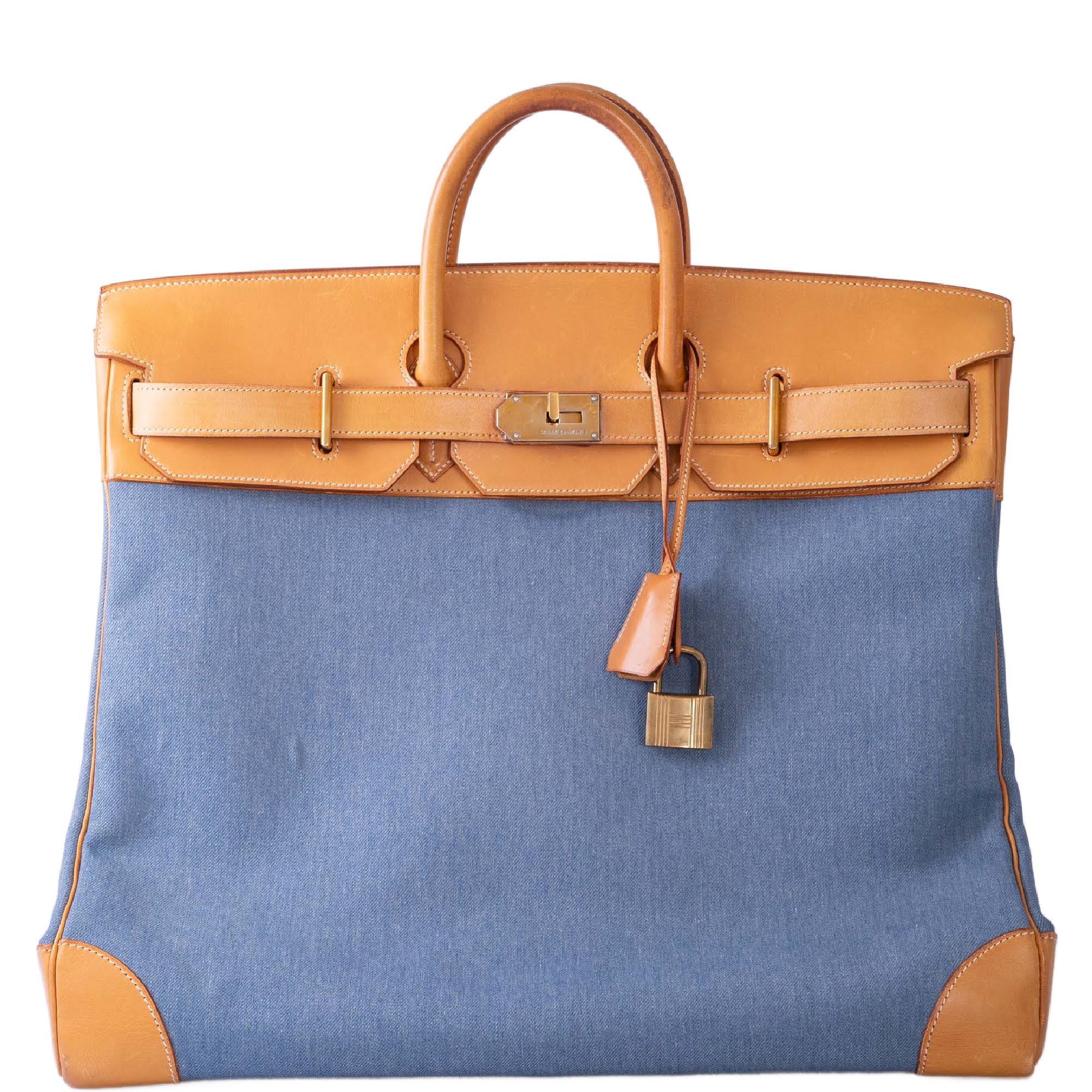
HAC 50: Denim and Naturelle Vache Liégée, Gold Hardware, 1998
The HAC 50 sits at the opposite pole. This is the travel scale: a size the Birkin has never occupied and never will, produced in small numbers for clients who wanted the house's construction at luggage dimensions. This example, from 1998 production, pairs Denim with Naturelle Vache Liégée trim, the pale saddle leather that tans and deepens with handling the way Barenia does. Where the black HAC 40 is formal and nocturnal, the 50 is utilitarian and sunlit: workwear textile against raw saddle leather, the equestrian origin story told in materials.
Naturelle trim is its own condition narrative. It leaves the atelier pale and darkens with every season of handling, so on a piece approaching thirty years old, the tone of the handles and straps is a record of its life. Collectors read that patina as provenance rather than wear. Denim, meanwhile, dates the piece culturally: Hermès' textile experiments of the late 1990s produced a small family of denim pieces that have aged from casual novelty into period documents. A denim HAC 50 is not a bag anyone buys by accident.
Side-by-side
Reading the pair: The 40 is texture and formality: suede against crocodile, black on black, a piece for a collector who wants the HAC silhouette in its most refined register. The 50 is scale and history: travel format, 1998 production, utilitarian materials with visible patina, a piece that points straight back at the bag's working origins. One is the HAC dressed for evening; the other is the HAC as Hermès first meant it. A collection with room for only one is choosing between refinement and origin story. A collection with room for both has bracketed the entire range of what this format can be.
Collecting the HAC today
HAC supply is structurally thin. Production has always been a fraction of Birkin output, the travel sizes appear only sporadically, and exotic or unusual-material examples like the two above surface a handful of times a year across the entire secondary market. Pricing is condition-led and configuration-led rather than driven by a liquid reference market, which rewards buyers who know exactly what they are looking at: date stamp, material verification, handle and corner condition, and completeness. As with all rare Hermès, the strongest examples tend to move through private channels before they are ever listed. JaneFinds sources and places HACs in both directions; the HAC Archive is the reference we work from, and it is published in full.