
Why Are Hermès Bags So Expensive?
The real answer — from 30 years in the market
The question gets asked constantly, usually by people who have just seen a price tag for the first time. A Birkin starts at roughly $10,000 for standard leather at boutique. A Kelly in Epsom is in the same range. Exotic skins begin at $40,000 and climb from there. Diamond hardware configurations cross $400,000. And on the secondary market, the best examples routinely sell at 150% of retail or more.
The short answer is that Hermès bags cost what they cost because of how they are made, what they are made from, how few of them exist, and what 180+ years of consistent quality has done to their position in the market. The longer answer requires understanding each of those factors in detail.

Craftsmanship
Every Hermès bag is made by one artisan, from first cut to final stitch. No assembly line. No division of labor across specializations. One person, one bag, start to finish. A Kelly takes 18–24 hours to complete. A Birkin in standard leather takes approximately the same. An exotic skin bag with complex hardware can take significantly longer.
Saddle stitching
The structural foundation of every Hermès bag is the saddle stitch — a technique inherited directly from the house's saddlery origins. Two needles, one thread, each stitch locked independently. If one stitch breaks, the seam holds. Machine stitching locks only at intervals, so a break propagates. The saddle stitch cannot be replicated at machine speed without losing its structural integrity — which is precisely why Hermès still uses it by hand on every bag.
Artisan training
Hermès artisans train for a minimum of two years before producing a bag that reaches a client. The apprenticeship covers leather selection, cutting, saddle stitching, edge finishing, and hardware installation. The standard for stitching alone — tension, spacing, angle — is exacting enough that most trainees spend months on stitching practice alone before moving to full bag construction.
Precision at every stage
Stitch symmetry is measured. Leather pattern alignment across panels is verified. Every edge is hand-painted with multiple coats of color-matched glaze. Hardware is fitted by hand and tested for function and finish before the bag is closed. A bag that fails inspection at any point is reworked or destroyed — it does not reach the floor.
Materials
Hermès sources leather from a small number of tanneries, several of which it owns outright. This vertical integration is not incidental — it gives the house direct control over hide selection, tanning process, and finishing standards at the source.
Standard calfskins
Togo, Clémence, Epsom, Swift, and Box Calf are the primary production leathers. Each is selected from hides that meet specific grain, thickness, and surface criteria. Hides that don't pass are redirected. The rejection rate for premium calfskin is significant — most of what a tannery produces doesn't meet Hermès' specification.
Exotic skins
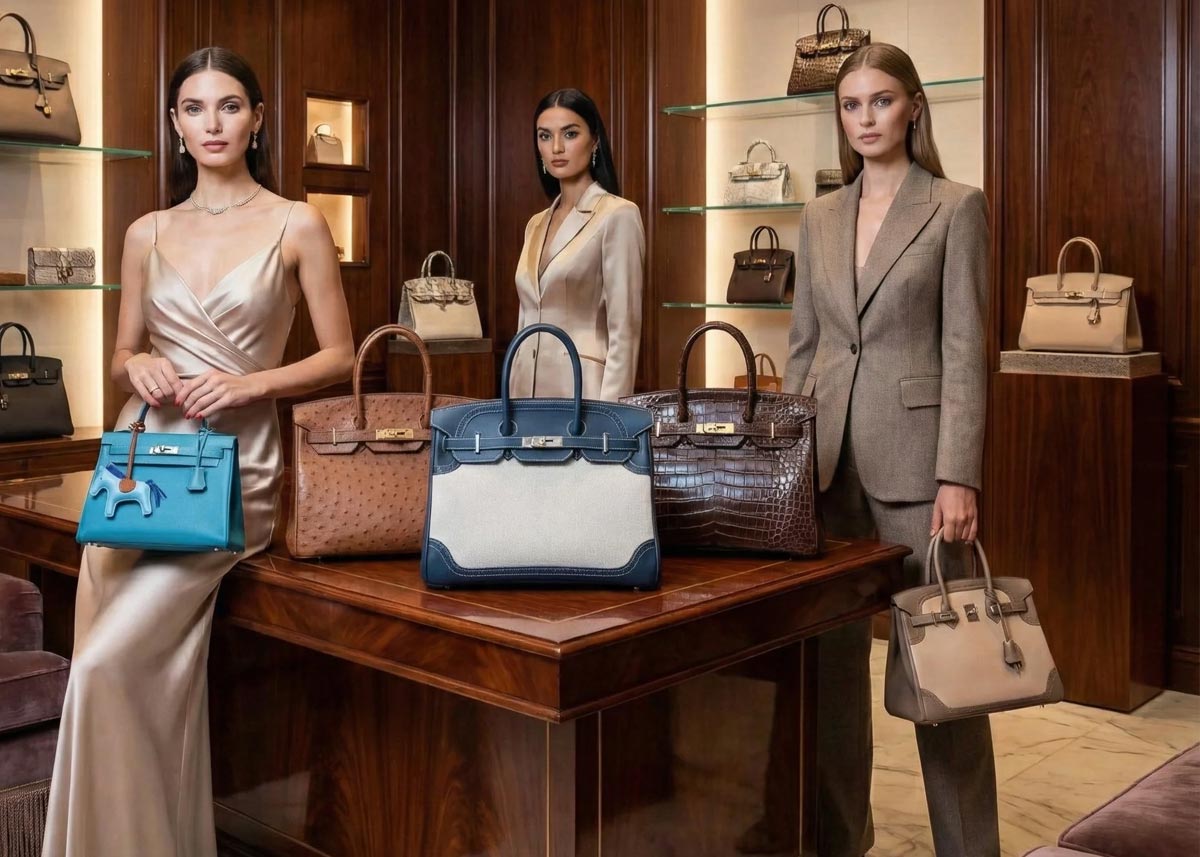
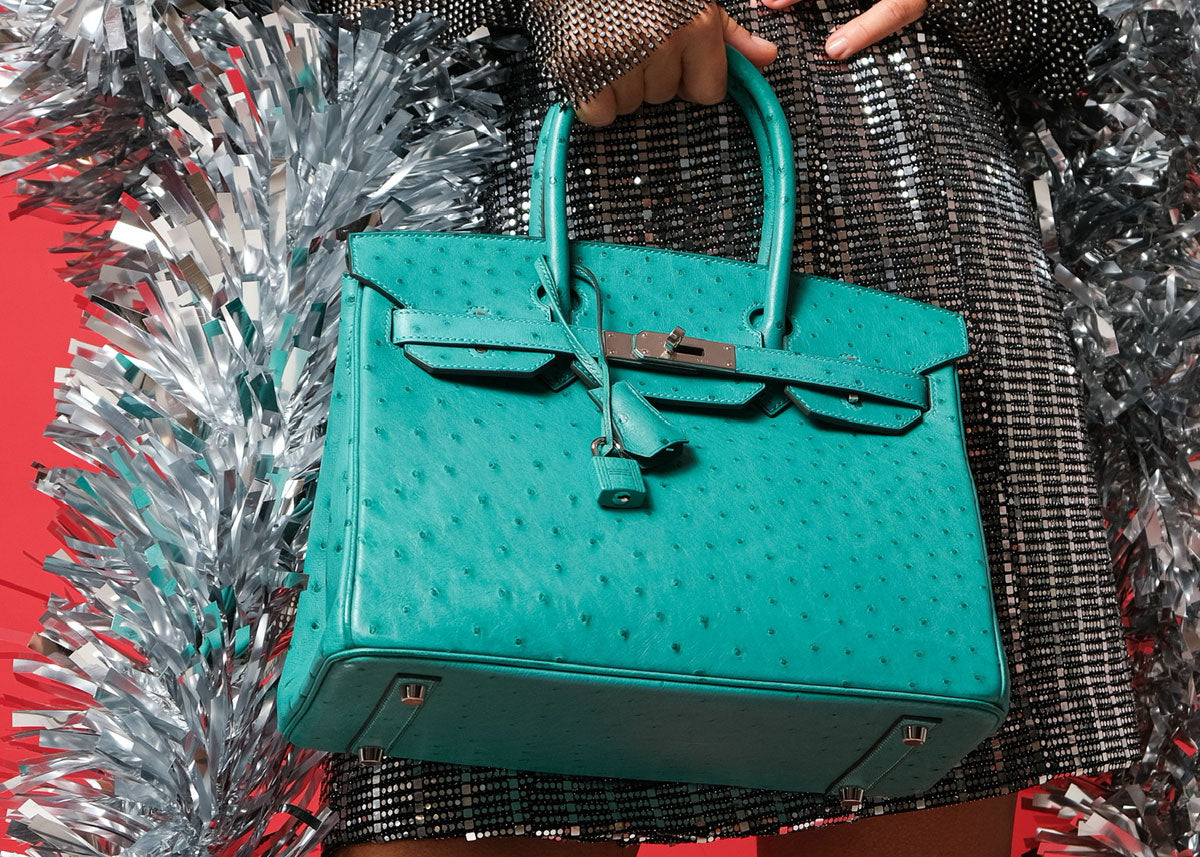
Porosus Crocodile, Niloticus Crocodile, Alligator Mississippiensis, Lizard, and Ostrich each require different tanning processes, different cutting expertise, and different construction techniques. A single Niloticus Crocodile Birkin may require up to three hides — only the belly panels, which have the most uniform scale pattern, are used for the bag body. The remainder of each hide is either used for smaller leather goods or discarded. This yield ratio is a primary driver of exotic skin pricing.
Hardware
Standard hardware is solid brass, plated to specification — 18-karat gold or palladium — at a thickness that maintains the finish under years of daily use. Exceptional Collection hardware uses solid 18-karat white gold set with VVS F diamonds. The lock on a Diamond Himalaya Birkin alone weighs over 68 grams of white gold and contains more than 40 diamonds. This is not decorative hardware — it is a jewelry commission that functions as bag hardware.
Production volume and exclusivity
Hermès produces approximately 12,000–15,000 Birkins annually across all sizes, leathers, and hardware combinations. Kelly production is similar. Against global demand — which exceeds supply by a significant multiple — this creates the conditions for the secondary market premiums that define the Birkin and Kelly as asset-class objects rather than simply luxury goods.
Standard leather
A Black Togo Birkin 30 with Palladium Hardware is considered a core configuration. Boutique waitlist: 1–3 years in most markets. Secondary market: 110–150% of retail. The most liquid Hermès position — deepest buyer pool, fastest conversion to cash.
Exotic skin
A Porosus Crocodile Birkin 25 in a sought-after color: estimated 300–500 globally produced per year across all sizes. Secondary market: 150–300%+ of retail. The buyer pool is smaller but highly motivated — condition commands extreme premiums.
Special Order (HSS)
Custom bi-color, Verso, or Multico configurations bearing the horseshoe stamp. Requires boutique relationship and invitation. Secondary market premiums: 50–150% over equivalent standard configurations for well-chosen color combinations.
Limited editions
Faubourg, Shadow, Cargo, Candy Collection, and season-specific releases. Production in the single or low double digits globally per year for the rarest formats. Secondary market: $100,000–$300,000+ for the apex configurations.
Heritage and the 187-year price of trust
Hermès was established in 1837 as a harness and saddlery workshop. The house has been producing leather goods to the same standard of quality — by hand, from premium materials, with full artisan accountability — for nearly two centuries. That continuity is not incidental to the pricing. It is the foundation of it.
Buyers at every price point in the Hermès catalog are purchasing not just a bag but a position within a 187-year record of consistent quality. No other luxury house has maintained that specific combination of handcraft, material sourcing, and production restraint for that duration. The price reflects the rarity of that record as much as it reflects the cost of the bag itself.
The Birkin's cultural history compounds this. Named for Jane Birkin following a chance meeting on a flight in 1984, it entered popular consciousness in 2001 and has been the most recognizable luxury object in the world for the two decades since. The Kelly, renamed for Grace Kelly in 1977 after she used the bag to shield her pregnancy from photographers in 1956, carries its own cultural weight. These are not brand narratives — they are documented events that are part of the object's identity.
Investment performance and secondary market
A 2016 study found that Birkin bags had outperformed the S&P 500 and gold as investment vehicles since the bag's introduction in 1984, appreciating at an average of 14.2% annually. Standard leather Birkins and Kellys in core configurations trade at 50–100% above retail on the secondary market. Exotic configurations trade at 150–300%+ above retail. The best HSS Special Orders command 50–150% premiums over equivalent standard bags.
The secondary market for Hermès bags is not speculative in the way that other collectible categories can be. Demand consistently exceeds supply at every price tier. The configurations that have performed best over time are not trend-driven — they are the rarest, best-conditioned examples of fundamentally strong configurations: small sizes in core leathers, exotic skins in universally flattering colors, discontinued hardware finishes in pristine condition.
JaneFinds record transactions
JaneFinds holds the record for the highest price ever achieved in a private Hermès resale transaction — over $1,700,000 for a single bag. We have also transacted a Diamond Himalaya Birkin at nearly $500,000.
These are private sale records, not auction results. They reflect the depth of the collector market that exists outside the auction circuit — buyers who know exactly what they want, have the expertise to authenticate it, and are willing to pay accordingly when the right piece becomes available.
After 30 years in this market, we have seen what drives value at every tier. The answer is consistent: rarity, condition, and authentication. Everything else is secondary.
The honest summary
Hermès bags are expensive because they are made differently from every other bag at any price point. One artisan. Premium materials sourced and controlled from the tannery. Deliberate production restraint that ensures demand permanently exceeds supply. And nearly two centuries of consistent quality that has made the house's name the most reliable signal of value in the luxury market.
The secondary market premiums are not artificial — they are the market's accurate read of what it costs to own a bag that cannot be easily replaced. A Black Togo Birkin 30 with Palladium Hardware bought at boutique retail today will sell for more than its purchase price in five years if it is kept in excellent condition. Few other objects at any price point offer that combination of daily utility and long-term value retention.


Leave a comment
This site is protected by hCaptcha and the hCaptcha Privacy Policy and Terms of Service apply.