
Hermès Birkin vs Kelly
A collector's guide to the key differences — construction, sizing, authentication, and market behavior
The Birkin and Kelly are often grouped together as Hermès' two flagship bag families, but they differ substantially in construction, intended use, authentication markers, and secondary market behavior. For a buyer choosing between them — or a collector who wants to understand what distinguishes each — the relevant differences go well beyond silhouette.
The Birkin

The Birkin dates to 1984, when Jane Birkin described her ideal travel bag to Hermès CEO Jean-Louis Dumas on a Paris-London flight. The resulting design drew on the existing HAC (Haut à Courroies) structure but at a wider, lower proportion suited to everyday carry. Its defining features — double rolled handles, a turn-lock closure with sangles straps, a clochette with lock and keys — have remained unchanged since original production.
Standard production spans 25, 30, 35, and 40 centimeters in Retourne construction: stitched on the inside, turned out, producing slightly rounded edges and a relaxed silhouette. The Sellier Birkin — stitched on the outside with crisp exposed edges — is produced occasionally but is not standard, and its appearance warrants close authentication. Current secondary market demand concentrates heavily in the 25 and 30; the 35, dominant through the mid-2010s, has moderated. The 40 is comparatively rare and appeals primarily to men and heavy travelers.
The Birkin's open-top design makes it functionally the more accessible of the two for daily carry. Its interior is a single large compartment with one zip pocket and one open patch pocket — spacious but not highly organized. The dual handles sit on the arm or in the hand; there is no shoulder strap.
The Kelly

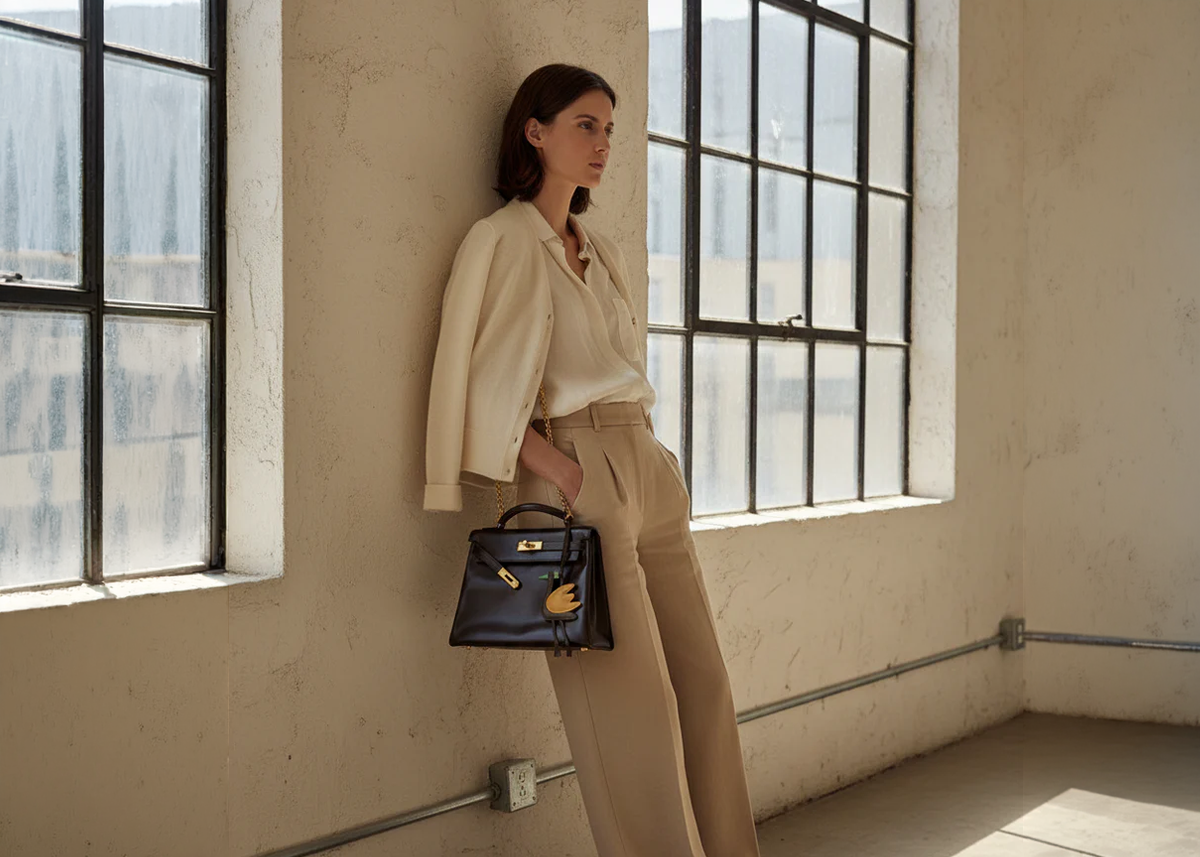
The Kelly predates the Birkin by decades. It originated as the Sac à Dépêches in the 1930s — a structured case for documents. Its global recognition came from a 1956 Life magazine photograph in which Grace Kelly, then Princess of Monaco, used it to shield her pregnancy from photographers. Hermès formalized the name in 1977.
The most important technical distinction in Kelly collecting is construction: Sellier versus Retourne. Sellier is stitched on the outside with a rigid internal frame, producing sharp corners, visible exterior topstitching, and a more formal, architectural silhouette. Retourne is stitched on the inside and turned out, yielding softer edges and a more relaxed profile. Both are produced across the same size range — 20, 25, 28, 32, 35, 40 — but certain leathers strongly favor one construction. Box calf is almost exclusively Sellier, where its inherent rigidity reinforces the sharp form. Clemence and Togo are predominantly Retourne, where the softer leather suits the relaxed construction. This pairing of leather to construction is one of the most consistent authentication reference points on Kelly bags.

The Kelly closes fully: the flap locks down with a turn-clasp and is secured by two sangles straps. This makes access slower than the Birkin but gives the bag a more composed presentation when carried. The single top handle is supplemented by a detachable shoulder strap, making the Kelly genuinely two-way in carry style — a significant practical distinction from the Birkin. The interior is more compartmentalized: one zip pocket and two open patch pockets, versus the Birkin's single zip and one open pocket.
Construction and authentication
Both bags share the same foundational Hermès construction: saddle-stitched by a single artisan using linen thread, two needles, hand-waxed. Stitch count per centimeter is consistent within each leather type and represents one of the primary authentication markers on both bags. On a genuine example, stitch spacing is even throughout; on counterfeits, spacing varies across the run.
The date stamp is the second critical marker. Both Birkins and Kellys carry a blind stamp (post-2015) or letter-within-shape stamp (pre-2015) inside the bag, typically on the interior left panel. The stamp identifies the production year and the artisan. Authenticators also examine hardware weight and finish, clochette lock mechanism, strap hardware, and edge paint consistency — all areas where counterfeit production consistently falls short.
Kelly-specific authentication point: The turn-lock clasp mechanism has evolved across generations. Early 1970s and 1980s clasps differ in proportion and operation from current production. Collectors who specialize in vintage Kellys develop fluency in clasp generations that is largely irrelevant to Birkin authentication. For a full authentication reference covering both bags, see the JaneFinds authentication guide.
Sizing and secondary market
Current secondary market demand concentrates at smaller sizes in both families. For Birkins, the 25 and 30 lead volume and premium. For Kellys, the Mini Kelly II (20cm, double gusset, Sellier only) is the most demanded single configuration in the house — its combination of scarcity, size, and design drives premiums that regularly exceed much larger bags in comparable leathers. As of 2025, Paris has restricted Special Orders to Mini Kelly II and Kelly Pochette only, further compressing new supply.
Exotic skin configurations behave differently in each family. An exotic Birkin — particularly Niloticus Crocodile — anchors the upper tier of the resale market globally, with Himalayan Birkins in any size commanding the highest prices. Exotic Kellys, particularly in Sellier construction (where sharp edges showcase the scale pattern most effectively), have their own strong collector constituency and are arguably rarer in pristine condition because the structured form shows wear at corners more visibly than the Birkin's rounded profile.
Which to choose
The practical answer depends on carry style and collecting intent. For daily functional use, the Birkin — particularly the 30 in Togo or Clemence — is more forgiving: faster to open, less structured, more volume. For a bag that transitions from day to evening, or that benefits from shoulder-carry flexibility, the Kelly's detachable strap is a meaningful advantage the Birkin doesn't offer.
For collectors focused on market liquidity, the Mini Kelly II in core colors currently outperforms the Birkin 25 in comparable leathers at the low end of the exotic-free market. For those focused on the highest-value configurations, the Himalaya Birkin remains the market's reference benchmark. For vintage collecting — pre-2000 examples in discontinued leathers — the Kelly's longer production history and greater construction variation make it the richer category.
Side-by-side reference
| Factor | Birkin | Kelly |
|---|---|---|
| Origin | 1984. Derived from the HAC. Named after Jane Birkin's conversation with CEO Jean-Louis Dumas. | 1930s as Sac à Dépêches. Renamed 1977 after Grace Kelly's 1956 Life magazine photograph. |
| Construction | Retourne standard. Sellier exists but is non-standard — encountering one warrants authentication scrutiny. | Both Sellier and Retourne are standard across all sizes. Construction choice is as significant as size. |
| Handles | Dual rolled top handles. Hand or arm carry only. No strap. | Single top handle plus detachable shoulder strap. Genuine two-way carry. |
| Closure | Flap can be left open or casually draped. Turn-lock and straps optional. | Flap must be fully closed with turn-lock and two sangles. Slower access, more formal presentation. |
| Interior | One large compartment. One zip pocket, one open patch pocket. | One zip pocket, two open patch pockets. More compartmentalized. |
| Standard sizes | 25, 30, 35, 40 cm. HAC variant also produced (taller proportion). | 20, 25, 28, 32, 35, 40 cm. Kelly Pochette and related formats also produced. |
| Leather pairing | Togo and Clemence most common in Retourne. Epsom used for both. Exotics in all standard sizes. | Box calf almost exclusively Sellier. Togo and Clemence predominantly Retourne. Pairing is a primary authentication marker. |
| Current market peak | B25 and B30 lead volume. Himalaya Birkin any size commands highest prices globally. | Mini Kelly II (20cm double gusset) most demanded single configuration. SO restricted to Mini II and Pochette only since 2025. |
| Vintage collecting | HAC and pre-1990 examples in discontinued leathers. Fewer construction variations than Kelly. | Richer vintage category: clasp generations, discontinued leathers, wider size and construction variation. |
| Daily practicality | More practical: faster access, larger volume, no closure requirement. | Shoulder strap is a significant functional advantage. Closure process adds formality and minor friction. |
Frequently asked questions
Both are allocation-restricted and require purchase history. Mini Kelly IIs and Kelly Pochettes are among the most difficult allocations in the house — Paris has restricted Special Orders to these two configurations only as of 2025. Standard Birkin 30s in Togo or Epsom appear more frequently in boutique allocation than Mini Kellys of comparable desirability.
Both retain value well in core leathers and colors. Himalaya Birkins set the global price ceiling. Mini Kelly IIs in black or neutral Epsom are currently outperforming Birkin 25s in comparable leathers on secondary market premium percentage. Exotic configurations in either family are less liquid but command higher absolute prices.
Sellier is stitched on the outside with a rigid internal frame, producing sharp corners and visible exterior topstitching. Retourne is stitched inside and turned out, yielding softer rounded edges. Sellier in Box calf is the most classically formal configuration; Retourne in Togo is the most practical for daily carry. On a Kelly, this distinction affects silhouette, wear trajectory, and collector preference — it is as important a specification as size.
The Birkin is generally more practical: faster access, slightly larger volume, no closure ritual. The Kelly's detachable shoulder strap is a genuine functional advantage the Birkin doesn't offer — particularly useful for travel or hands-free carry. For buyers who want a single bag that serves both casual and formal contexts, the Kelly with its strap is arguably more versatile.
Rare configurations — exotic skins, discontinued leathers, Exceptional Collection pieces — surface through specialist dealers with direct access to serious consignors. The rarest pieces are typically offered privately before they reach public channels. JaneFinds has sourced and sold pieces at every level of the market, including the highest price ever achieved for a single Hermès piece. Consign with JaneFinds or browse the current collection.
Primary markers: even saddle stitch count per centimeter, hardware weight and finish, clochette lock mechanism, edge paint consistency, and the blind stamp (post-2015) or letter-within-shape stamp (pre-2015) on the interior left panel. Kelly-specific: clasp generation. Birkin-specific: sangles strap hardware and clochette proportions. For a complete reference, see the JaneFinds authentication guide.



Leave a comment
This site is protected by hCaptcha and the hCaptcha Privacy Policy and Terms of Service apply.